
Complex Number Addition by Michael Holzmann
Loading the math board and drawing, please wait…
In collections
Complex numbers
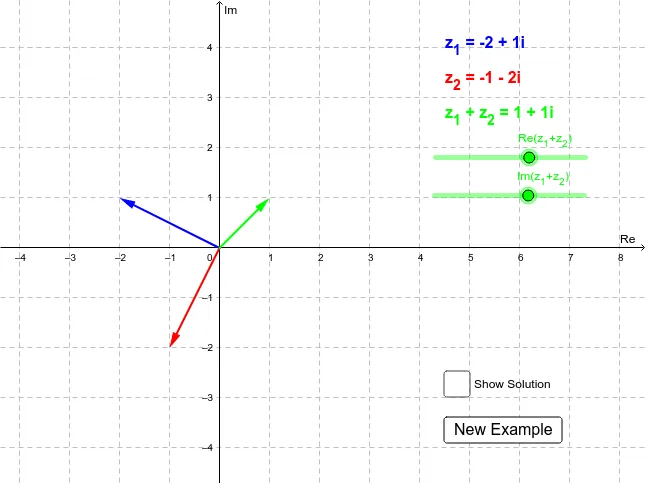
This example demonstrates how complex numbers can be visually represented as vectors in the complex plane, focusing on the geometric interpretation of complex number addition. Key math concepts include complex numbers, vectors, complex plane, and geometric addition. It is constructed using GeoGebra commands like Intersect and Vector, showing vector addition to illustrate complex addition. Suitable for high school students learning about vector representation and addition of complex numbers.
GeoGebra Commands & Parameters
Intersect(xAxis, yAxis) → AVector(A, Z_1) → uVector(A, Z_2) → vVector(A, Sum) → wVector(Z_1, S) → bVector(A, S) → a
AI Drawing Prompt Reference
Draw the complex plane with two vectors starting from the origin, each representing a complex number in different colors. Then draw the sum vector from the origin to the point that is the sum of the two complex numbers. From the tip of the first vector, draw a vector to the sum point, which should be parallel and equal in length to the second vector. Finally, draw a vector from the origin to the sum point as the resultant. This illustrates the parallelogram law for complex addition, with axes visible and arrows on all vectors.
The prompt above was compiled from the original drawing commands and is for reference only.