
Complex Multiplication with Unit Length
Loading the math board and drawing, please wait…
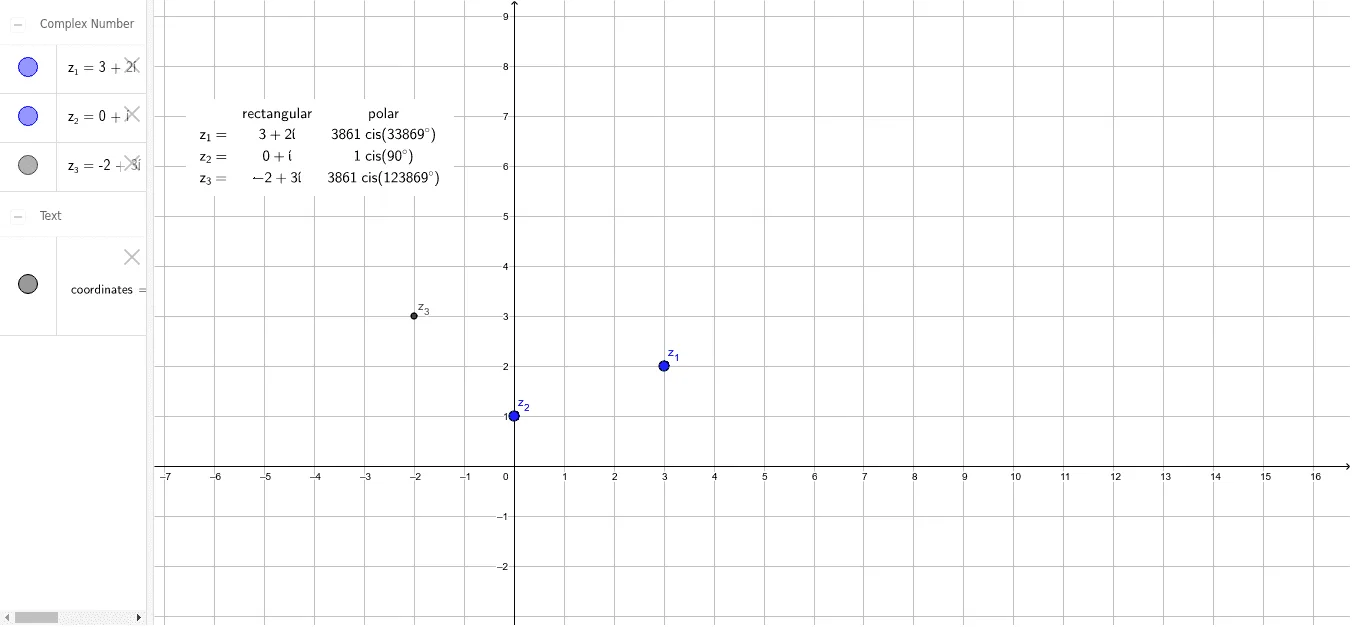
This example demonstrates the geometric interpretation of complex multiplication with unit length, visually showing how multiplication of complex numbers leads to rotation of angles and changes in modulus. Core mathematical concepts include the geometric representation of complex numbers, modulus, argument, and rotational transformations. Construction highlights the use of GeoGebra commands and objects like Circle, Point, Length, and Angle to build complex numbers, unit circles, and rotation effects. Suitable for high school and above mathematics learners to understand the intuitive geometric meaning of complex operations.
GeoGebra Commands & Parameters
Circle((0, 0), 1) → unitPoint(unit) → z_2Length(z_1) → r_1Length(z_2) → r_2Length(z_3) → r_3Angle(z_1) → θ_1Angle(z_2) → θ_2Angle(z_3) → θ_3
AI Drawing Prompt Reference
Draw a unit circle centered at the origin. Place a point on the circle to represent a complex number with modulus 1. Also show two other complex points, measuring their moduli and arguments. Use the point on the unit circle and the two complex points to illustrate that complex multiplication results in multiplying moduli and adding arguments, showing rotation and scaling. Include the unit circle, the three complex points, line segments for moduli, and angle markers for arguments.
The prompt above was compiled from the original drawing commands and is for reference only.