
Comparing Fractions with Same Numerator (Interactive GeoGebra)
Loading the math board and drawing, please wait…
In collections
Zahlenstrahl und Ordnen von Brüchen
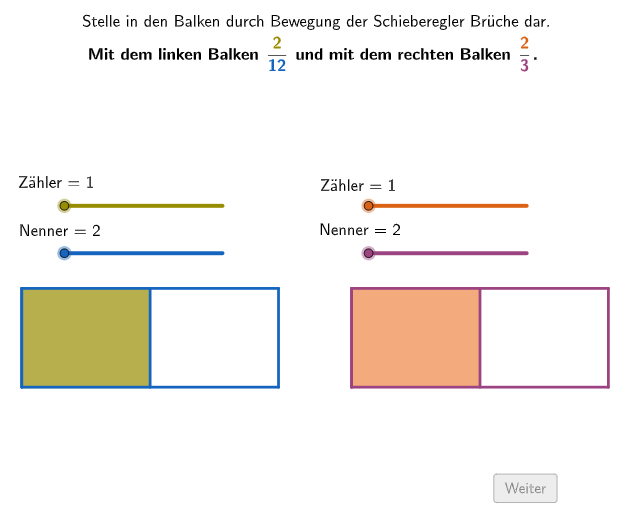
This interactive GeoGebra activity, designed for grades 5-6, visually demonstrates how to compare fractions that share the same numerator using circular area models (BruchKreis). The core mathematical concept is the rule for comparing like-numerator fractions: the larger the denominator, the smaller the fraction value. The construction uses commands such as Shuffle, Polygon, Sequence, Distance, and SelectedIndex to generate random fraction pairs, along with sliders and buttons (btnCont, btnAgain) to control the practice flow. Text input fields and dropdown menus support open-ended questions that challenge common misconceptions, such as Ollie's claim that a larger denominator means a larger fraction. This resource is ideal for classroom instruction or independent student exploration, reinforcing the interpretation of fractions as relative parts of a whole.
GeoGebra Commands & Parameters
Shuffle({1, 2, 3, 4, 5, 6, 7, 8, 9}) → RandomZaehler, {2, 1, 9, 6, 7, 5, 8, 4, 3}Shuffle(Sequence[i, i, zaehler + 1, 13] \ {zaehler}) → RandomNenner1, {12, 5, 4, 13, 7, 9, 11, 10, 3, 6, 8}Shuffle(Sequence[i, i, zaehler + 1, 13] \ {nenner1, nenner1 + 1, nenner1 - 1, zaehler}) → RandomNenner2, {3, 5, 9, 7, 10, 4, 6, 8}Polygon(BruchVieleck1E1, BruchVieleck1E2, BruchVieleck1E3, BruchVieleck1E4) → BruchVieleck1, a_1, b, c, dPolygon(BruchVieleck2E1, BruchVieleck2E2, BruchVieleck2E3, BruchVieleck2E4) → BruchVieleck2, e, f, g, hSequence(BruchVieleck1E1 + ((6.5 * k / schiebenenner1), 0), k, 0, schiebenenner1) → PunkteBalken1ObenSequence(BruchVieleck1E2 + ((6.5 * k / schiebenenner1), 0), k, 0, schiebenenner1) → PunkteBalken1UntenSequence(BruchVieleck2E1 + ((6.5 * k / schiebenenner2), 0), k, 0, schiebenenner2) → PunkteBalken2ObenSequence(BruchVieleck2E2 + ((6.5 * k / schiebenenner2), 0), k, 0, schiebenenner2) → PunkteBalken2UntenSequence(Polygon[PunkteBalken1Oben(k), PunkteBalken1Oben(k + 1), PunkteBalken1Unten(k + 1), PunkteBalken1Unten(k)], k, 1, schiebezaehler1) → FlächenBalkenZaehler1Sequence(Segment[PunkteBalken1Oben(k), PunkteBalken1Unten(k)], k, 1, schiebenenner1) → StreckenBalken1Sequence(Segment[PunkteBalken2Oben(k), PunkteBalken2Unten(k)], k, 1, schiebenenner2) → StreckeBalken2Sequence(Polygon[PunkteBalken2Oben(k), PunkteBalken2Oben(k + 1), PunkteBalken2Unten(k + 1), PunkteBalken2Unten(k)], k, 1, schiebezaehler2) → FlächeBalkenZaehler2Distance(BruchVieleck1E1, BruchVieleck2E1) → aSequence(BruchVieleckAnimE1 + ((6.5 * k / schiebenenner1), 0), k, 0, schiebenenner1) → PunkteBalkenAnimObenSequence(BruchVieleckAnimE2 + ((6.5 * k / schiebenenner1), 0), k, 0, schiebenenner1) → PunkteBalkenAnimUntenSequence(Polygon[PunkteBalkenAnimOben(k), PunkteBalkenAnimOben(k + 1), PunkteBalkenAnimUnten(k + 1), PunkteBalkenAnimUnten(k)], k, 1, schiebezaehler1) → FlächenBalkenAnimSelectedIndex(DropDown1) → Index1SelectedIndex(DropDown2) → Index2SelectedIndex(DropDown3) → Index3
AI Drawing Prompt Reference
Create an interactive math visualization for comparing fractions. Show two vertical bar charts placed side by side, each representing a fraction with the same numerator but different denominators. Each bar is divided into equal segments by vertical lines at the bottom, with the upper shaded portion representing the numerator. The more segments (larger denominator), the smaller each part becomes. Include a button below to randomly generate new fraction pairs for practice, demonstrating that with equal numerators, larger denominators result in smaller fraction values.
The prompt above was compiled from the original drawing commands and is for reference only.