
Combinations of Different Cards (Distinguishable Objects)
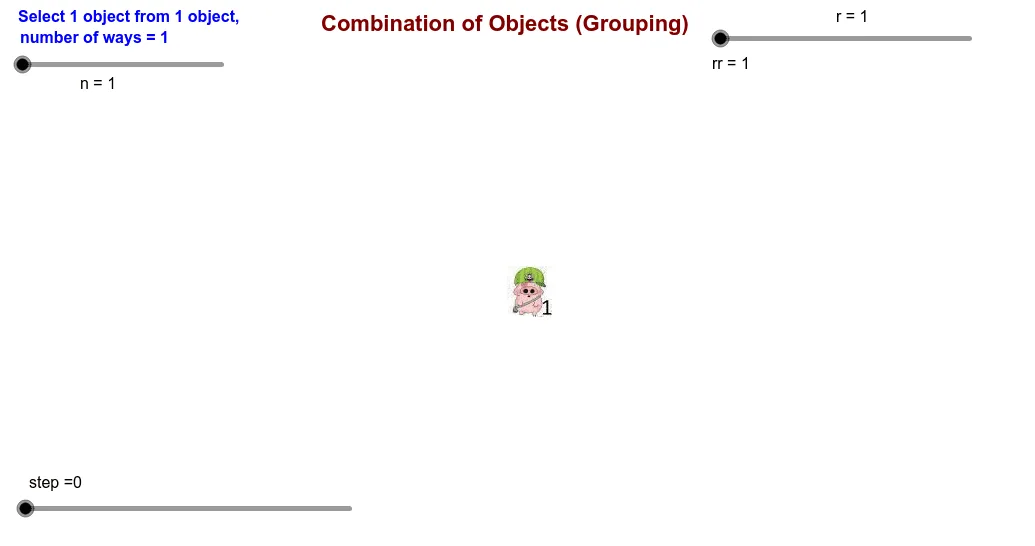
This example demonstrates the calculation of combinations when selecting r objects from n different distinguishable objects (1 to 6). It visually illustrates all possible combinations and the corresponding binomial coefficient C(n,r). Interactive sliders allow dynamic adjustment of n and r values, displaying combination scenarios in real time. Ideal for teaching combinatorics fundamentals and probability statistics basics in high school mathematics. The applet presents cards numbered 1 through 6, each representing a unique distinguishable object. When users adjust the n slider to change the total number of available objects and the r slider to change how many are selected, the applet instantly generates and displays every possible combination using card visuals. Each combination is shown as a distinct group of cards, allowing students to see firsthand how the number of outcomes corresponds to the value of C(n,r). The binomial coefficient is displayed numerically alongside the visual arrangement, reinforcing the connection between the abstract formula and concrete counting. This dual representation helps learners internalize why combinations differ from permutations by emphasizing that order does not matter in a combination. The dynamic nature of the sliders enables rapid exploration of different scenarios, encouraging students to observe patterns such as the symmetry property C(n,r) = C(n,n-r) and the relationship between consecutive rows of Pascal's Triangle. The applet is well-suited for classroom instruction, independent practice, or flipped learning activities, providing an intuitive entry point into the study of counting principles before students encounter more formal algebraic derivations of the combination formula.
Loading the math board and drawing, please wait…