
Birthday Problem Visualization: Geometric Construction for Repeat Probability
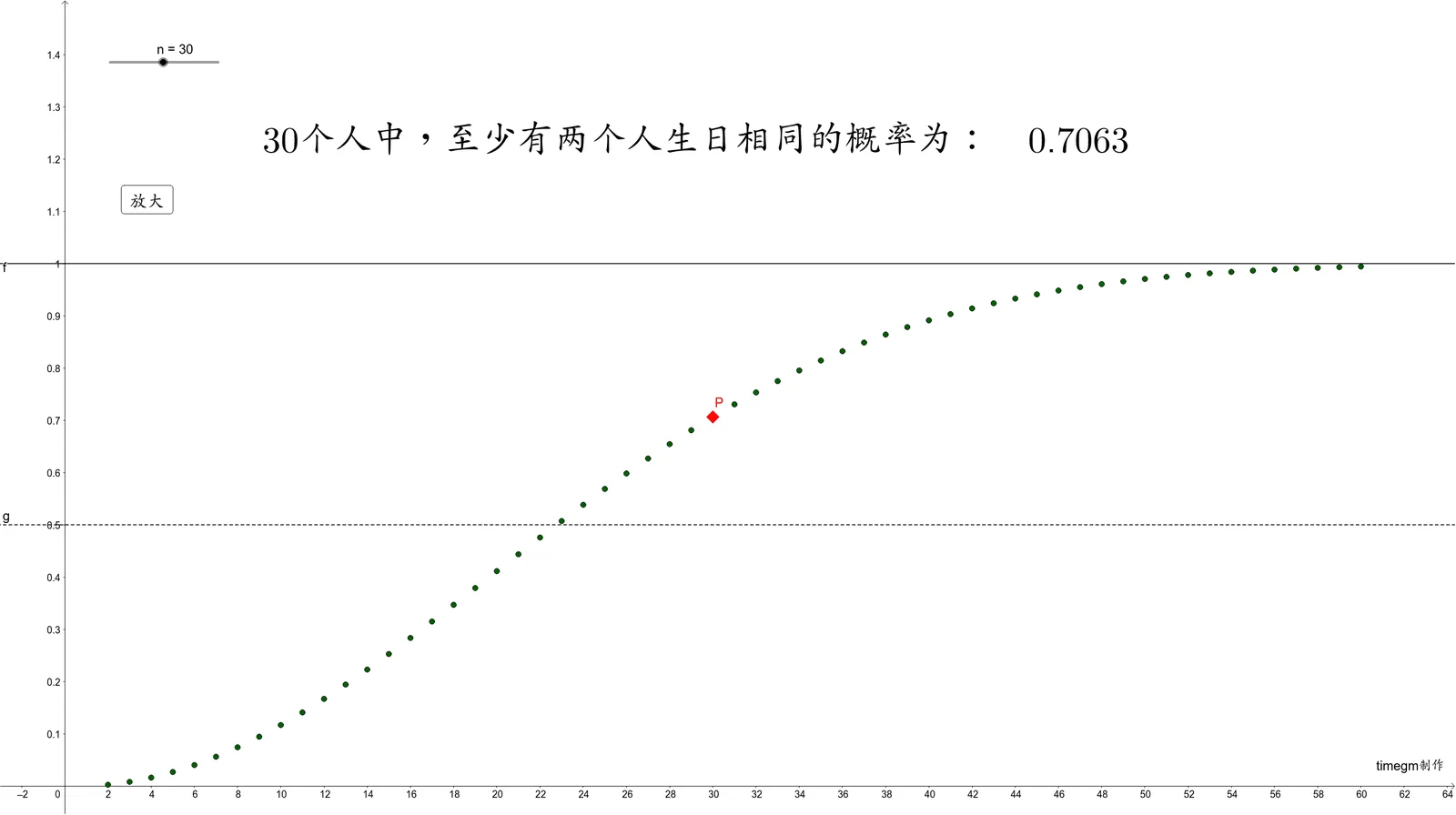
This example demonstrates the birthday problem’s probabilistic setup by visualizing how the probability of shared birthdays changes as the number of people increases. It focuses on modeling complementary events (no match vs. at least one match) using core ideas from combinatorial probability, and it connects the notion of “repeat structure” to equation-based constraints and periodic overlap concepts related to least common multiple and greatest common divisor. From the GeoGebra construction summary, it is built with batch parameter handling and aggregation using commands such as Zip and Sum; interactive parameters like n (number of people) and additional variables (a, b, c, d) that define interval/mod/group structure; a probability-related value p; and a set of indexed geometric objects (A1…A15, B1…B15) with labels/text (text1, button1). Function objects (f, g) are used to compute and display the relevant probability/constraint behavior, resulting in an interactive geometric-probability visualization. Suitable for upper secondary through introductory university probability/statistics teaching.
Loading the math board and drawing, please wait…