
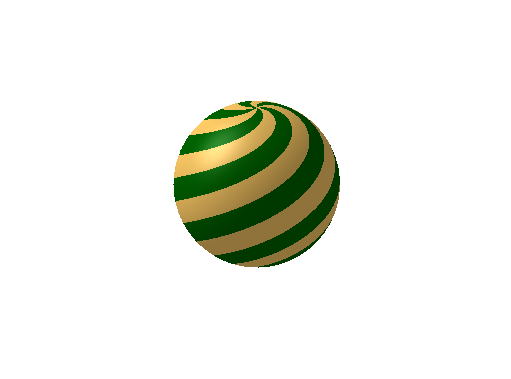
Colorful Sphere 1: Parametric Surface with Combinatorial Point Grid
Loading the math board and drawing, please wait…
In collections
My 3D Collection
① This example demonstrates a vividly colored sphere (Kolorowa kula) constructed using GeoGebra's Surface command, showcasing how parametric surfaces are generated in 3D space. ② Core mathematical concepts include parametric equations, surface construction, spatial point sets, and combinatorial arrangements of points, integrating functions, straight lines, and hyperbolas. ③ Construction highlights: Based on the summary, the Surface command is used, along with multiple point objects A1–A10, B1–B10, and C1–C10, which likely serve as control points or a parametric grid, combined to create colorful textures or discrete point patterns on the sphere, illustrating parametric modeling and combinatorial design. ④ Suitable for high school to university-level mathematics, especially in analytic geometry, solid geometry, or computer-aided geometric design, helping learners understand the relationship between parametric surfaces and spatial point sets, and useful for mathematical art or visualization exploration.
GeoGebra Commands & Parameters
Surface((cos(k) * cos(a + (2 * k))), (cos(k) * sin(a + (2 * k))), sin(k), k, (-π) / 2, π / 2, a, A1, B1) → C1Surface((cos(k) * cos(a + (2 * k))), (cos(k) * sin(a + (2 * k))), sin(k), k, ((-π)) / 2, π / 2, a, A2, B2) → C2Surface((cos(k) * cos(a + (2 * k))), (cos(k) * sin(a + (2 * k))), sin(k), k, ((-π)) / 2, π / 2, a, A3, B3) → C3Surface((cos(k) * cos(a + (2 * k))), (cos(k) * sin(a + (2 * k))), sin(k), k, ((-π)) / 2, π / 2, a, A4, B4) → C4Surface((cos(k) * cos(a + (2 * k))), (cos(k) * sin(a + (2 * k))), sin(k), k, ((-π)) / 2, π / 2, a, A5, B5) → C5Surface((cos(k) * cos(a + (2 * k))), (cos(k) * sin(a + (2 * k))), sin(k), k, ((-π)) / 2, π / 2, a, A6, B6) → C6Surface((cos(k) * cos(a + (2 * k))), (cos(k) * sin(a + (2 * k))), sin(k), k, ((-π)) / 2, π / 2, a, A7, B7) → C7Surface((cos(k) * cos(a + (2 * k))), (cos(k) * sin(a + (2 * k))), sin(k), k, ((-π)) / 2, π / 2, a, A8, B8) → C8Surface((cos(k) * cos(a + (2 * k))), (cos(k) * sin(a + (2 * k))), sin(k), k, ((-π)) / 2, π / 2, a, A9, B9) → C9Surface((cos(k) * cos(a + (2 * k))), (cos(k) * sin(a + (2 * k))), sin(k), k, ((-π)) / 2, π / 2, a, A10, B10) → C10