
Coin Rotation Paradox
Loading the math board and drawing, please wait…
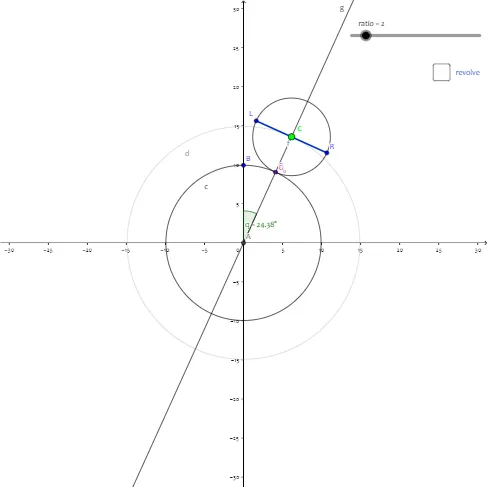
Illustrates the coin rotation paradox involving rotation, linear functions, and straight lines. Using GeoGebra commands such as circle, segment, angle, and rotate, it demonstrates geometric transformations of a coin's rotation. Suitable for high school mathematics education and learning.
GeoGebra Commands & Parameters
Intersect(xAxis, yAxis) → APoint(yAxis) → BCircle(A, (Distance[A, B] * (ratio + 1) / ratio)) → dPoint(d) → CCircle(C, Distance[A, B] / ratio) → eRadius(e) → reLine(A, C) → gCircle(A, B) → cIntersect(c, g, 2) → GAngle(G, A, B) → qIf(b, Rotate[G, (-rq), C], G) → G_0Angle(G_0, C, G) → α'Rotate(G, π / 2 - If[b, rq, hq], C) → RRotate(G, (3 * π / 2) - If[b, rq, hq], C) → LSegment(L, R) → fRadius(d) → aRadius(d) → rd
AI Drawing Prompt Reference
Draw a coin rotation paradox illustration, starting with the intersection point A of a horizontal and vertical line, then draw two circles d and e with A and B as centers respectively. Draw a line g connecting A and C, and another circle c with A and B as centers. Mark the angle q at the intersection of g and c, then rotate G to generate G_0 and the angle α', and rotate G again to generate L and R. Finally, draw the line segment f connecting L and R.
The prompt above was compiled from the original drawing commands and is for reference only.