
Climbing Game
Loading the math board and drawing, please wait…
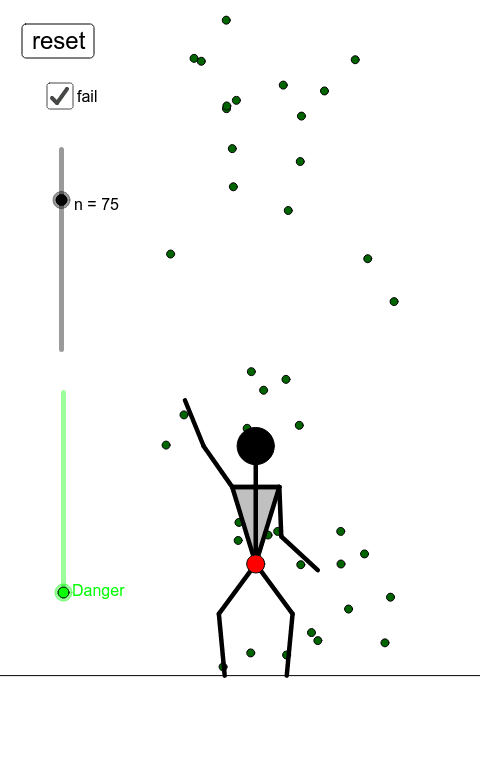
A mini game that simulates mathematical sequences and probability through climbing. It demonstrates the concept of sequences and how to construct dynamic graphics using GeoGebra commands such as Sequence, Intersect, Rotate, ClosestPoint, etc. Suitable for middle school and above students to learn probability and sequences.
GeoGebra Commands & Parameters
Sequence(((4 * random()), (20 * random())), i, 1, n) → liste1Intersect(Circle[O, 1.9], Ray[O, Mirror[Midpoint[P_1, P_2], O]]) → T,Rotate(Dilate[T, 0.6, O], -130°, O) → Pv2ClosestPoint(liste1, Pv2) → PP_2Rotate(Dilate[O, 0.4, T], 30°, T) → E_2Rotate(Dilate[O, 0.4, T], -30°, T) → E_1Rotate(Dilate[T, 0.6, O], 130°, O) → Pv1Intersect(Circle[O, 1], Circle[P_2, 1], 1) → G_2Segment(O, G_2) → dSegment(G_2, P_2) → eCircle(T, 0.3) → teteSegment(O, T) → f_1Segment(E_1, E_2) → gIntersect(Circle[E_1, 0.8], Circle[M_1, 0.8], 1) → C_1Segment(E_1, C_1) → hSegment(C_1, M_1) → iIntersect(Circle[E_2, 0.8], Circle[M_2, 0.8], 2) → C_2Segment(E_2, C_2) → jSegment(C_2, M_2) → kIntersect(Circle[O, 1], Circle[P_1, 1], 2) → G_1Segment(G_1, P_1) → bSegment(O, G_1) → aRotate(Dilate[O, 0.9, E_1], -150°, E_1) → Mv1ClosestPoint(liste1, Mv1) → MM_1Rotate(Dilate[O, 0.9, E_2], 150°, E_2) → Mv2ClosestPoint(liste1, Mv2) → MM_2ClosestPoint(liste1, Pv1) → PP_1IndexOf(Max[liste2], liste2) → maIf(m ≟ 1 ∧ (Distance[M_1, MM_1] > 0.05), 1, 0) → v1If(m ≟ 2 ∧ (Distance[M_2, MM_2] > 0.05), 1, 0) → v2If(m ≟ 3 ∧ (Distance[P_1, PP_1] > 0.05), 1, 0) → v3If(m ≟ 4 ∧ (Distance[P_2, PP_2] > 0.05), 1, 0) → v4Polygon(E_1, E_2, O) → poly1, o, e_1, e_2Sum(liste3) → c