
Cliff Diver's Parabolic Trajectory and Geometric Construction
Loading the math board and drawing, please wait…
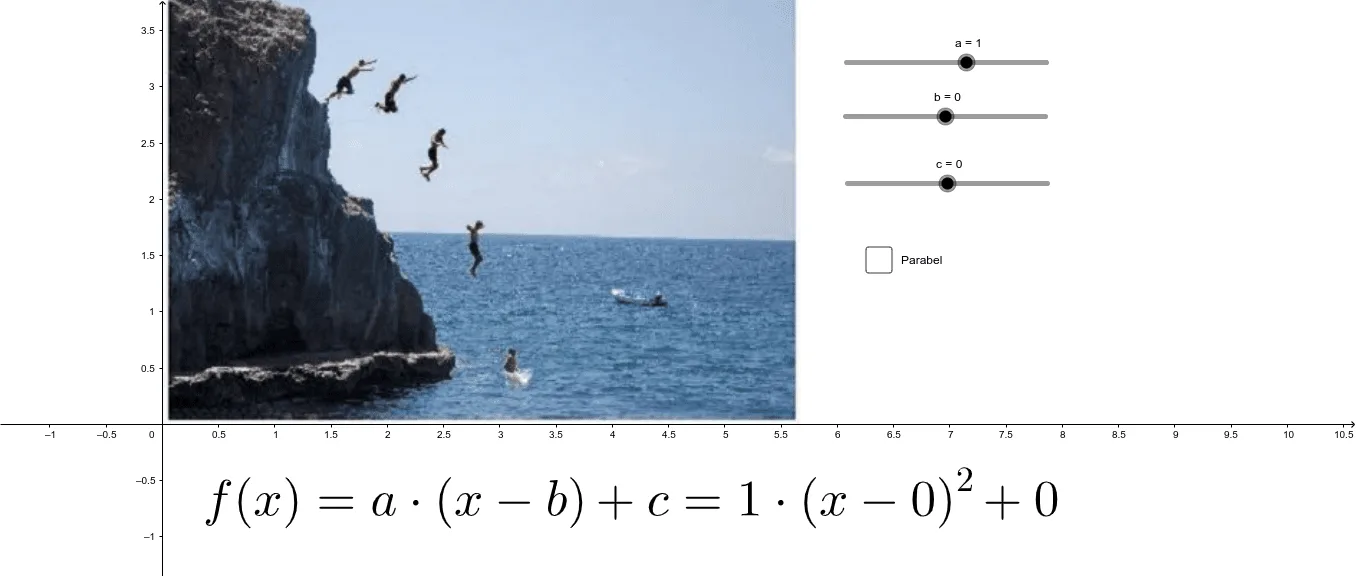
This GeoGebra example dynamically illustrates the motion of a cliff diver (Klippenspringer), modeling the diving path as a parabola while overlaying geometric elements such as a sphere and polygons to show the connection between quadratic functions and geometric objects. Core mathematical concepts include quadratic functions, derivatives, geometric mean, median lines, spheres, and polygons. Construction highlights: based on the summary, the example uses points A and B, image Bild1, lines a, b, c, function f, text Text1, point S, and segment d as GeoGebra objects, defining the trajectory and auxiliary lines through function definitions and geometric constraints. It is suitable for upper secondary or pre-university students learning quadratic function graphs, the geometric meaning of derivatives, and integrated applications of algebra and geometry, as well as for visualizing projectile motion in physics.
GeoGebra Commands & Parameters
Point A(0.0, 0.0)Point B(5.68, 0.0)Numeric a(1.0)Numeric b(0.0)Numeric c(0.0)f(x) = (a * (x - b)^(2)) + c(b, c)Boolean d(false)
AI Drawing Prompt Reference
Create a coordinate-plane graphic showing a parabolic trajectory. Mark two key points as endpoints: one at (0,0) and another at (5.68,0). Plot the parabola using a parameterized quadratic function f(x)=a(x-b)^2+c with a=1, b=0, c=0, so the curve is determined by these parameter values and aligned with the coordinate system. Highlight the point (b,c) = (0,0) as an important reference, and display the construction so the relationship between the quadratic function’s geometry and the marked point/trajectory is visually clear.
The prompt above was compiled from the original drawing commands and is for reference only.