
Circumference and Radius
Loading the math board and drawing, please wait…
In collections
Exploration: One Special Constant
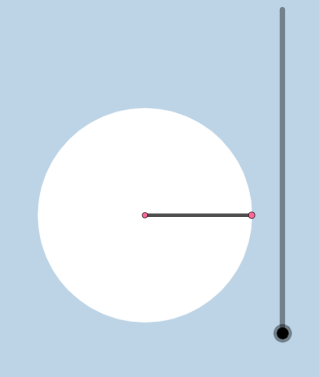
This example demonstrates the relationship between circles and triangles through geometric construction. Key mathematical concepts include circumference, radius, triangle angles and side ratios, and geometric construction techniques. The construction involves GeoGebra commands such as Segment, Rotate, CircleArc, Intersect, etc. Suitable for middle school or high school students learning geometry fundamentals and transformations.
GeoGebra Commands & Parameters
Segment((0, 0), (r, 0)) → fRotate((r, 0), 1, (0, 0)) → ARotate((r, 0), 2, (0, 0)) → BRotate((r, 0), 3, (0, 0)) → CRotate((r, 0), 4, (0, 0)) → DRotate((r, 0), 5, (0, 0)) → ERotate((r, 0), -1, (0, 0)) → FRotate(f, If[0 < a ≤ 1, ((-a) * pi / 2), ((-pi)) / 2], (r, 0)) → f'Rotate(G, If[1.5 < a ≤ 2.5, a - 1.5, 1], (0, 0)) → G'CircleArc((0, 0), G, G') → cCircle(G', r - c) → dLine((0, 0), G') → gOrthogonalLine(G', g) → hIntersect(d, h, 2) → HSegment(G', H) → iDilate(G, If[3 < a ≤ 4, 4 - a, 0], A) → G'_{1}Vector(G, G'_{1}) → uTranslate(f, u) → f'_{1}Line((0, 0), A) → jOrthogonalLine(A, j) → kPoint(p) → IPoint(k) → JAngle(J, A, I) → αRotate(f'_{1}, If[3 < a ≤ 4, ((-(a - 3)) * α), (-α)], G'_{1}) → lRotate(A, If[4 < a ≤ 5, a - 4, 1], (0, 0)) → A'CircleArc((0, 0), A, A') → eCircle(A', r - e) → qLine((0, 0), A') → mOrthogonalLine(A', m) → nIntersect(q, n, 2) → KSegment(A', K) → sDilate((0, 0), If[5.5 < a ≤ 6.5, 6.5 - a, 0], B) → LVector(M, L) → vTranslate(f, v) → f'_{2}Line(M, B) → bOrthogonalLine(B, b) → f_1Point(t) → NPoint(f_1) → OAngle(O, B, N) → βRotate(f'_{2}, If[5.5 < a ≤ 6.5, ((-(a - 5.5)) * β), (-β)], L) → g_1Rotate(B, If[6.5 < a ≤ 7.5, a - 6.5, 1], (0, 0)) → B'CircleArc(M, B, B') → c_1Line(M, B') → h_1OrthogonalLine(B', h_1) → i_1Circle(B', r - c_1) → d_1Intersect(d_1, i_1, 2) → PDilate(M, If[8 < a ≤ 9, 9 - a, 0], C) → M'Vector(M, M') → wTranslate(f, w) → f'_{3}Line(M, C) → k_1OrthogonalLine(C, k_1) → l_1Point(p_1) → QPoint(l_1) → RAngle(R, C, Q) → γRotate(f'_{3}, If[8 < a ≤ 9, ((-(a - 8)) * γ), (-γ)], M') → m_1Rotate(C, If[9 < a ≤ 10, a - 9, 1], M) → C'CircleArc(M, C, C') → e_1Line(M, C') → n_1OrthogonalLine(C', n_1) → q_1Circle(C', r - e_1) → r_1Intersect(r_1, q_1) → S, B_1Intersect(d_1, i_1, 1) → TDilate(M, If[10.5 < a ≤ 11.5, 11.5 - a, 0], D) → M'_{1}Vector(M, M'_{1}) → u_1Translate(f, u_1) → f'_{4}Line(M, D) → a_1OrthogonalLine(D, a_1) → b_1Point(b_1) → UPoint(t_1) → VAngle(U, D, V) → δRotate(f'_{4}, If[10.5 < a ≤ 11.5, ((-(a - 10.5)) * δ), (-δ)], M'_{1}) → f_2Rotate(D, If[11.5 < a ≤ 12.5, a - 11.5, 1], M) → D'CircleArc(M, D, D') → c_2Line(M, D') → g_2OrthogonalLine(D', g_2) → h_2Circle(D', r - c_2) → d_2Intersect(d_2, h_2, 2) → WSegment(D', W) → i_2Intersect(d_2, h_2, 1) → ZRotate(M, If[13 < a ≤ 14, ((a - 13) * pi / 2), pi / 2], G) → M'_{2}Segment(G, M'_{2}) → j_2If(x(P) ≤ x(T), P, T) → A_1Segment(B', A_1) → j_1If(y(B_1) < y(S), B_1, S) → C_1Segment(C', C_1) → s_1Rotate(G, If[14 < a ≤ 15, (-(a - 14)), -1], M) → G'_{2}CircleArc(M, G'_{2}, G) → e_2Line(M, G'_{2}) → k_2Circle(G'_{2}, r - e_2) → p_2OrthogonalLine(G'_{2}, k_2) → l_2Intersect(p_2, l_2) → D_1, E_1If(y(D_1) ≤ y(E_1), D_1, E_1) → F_1Segment(G'_{2}, F_1) → m_2Rotate(D, 1, M) → D'_{1}Rotate(G, 0.5) → G'_{3}Rotate(G, 1.5) → G'_{4}Rotate(G, 2.5) → G'_{5}Rotate(G, 3.5) → G'_{6}Rotate(G, 4.5) → G'_{7}Rotate(G, -0.5) → G'_{8}Segment(G_1, G) → n_2Circle(G_1, n_2 / 7) → q_2Intersect(q_2, n_2, 1) → H_1Mirror(G_1, H_1) → I_1Mirror(H_1, I_1) → J_1Mirror(I_1, J_1) → K_1Mirror(J_1, K_1) → L_1Mirror(K_1, L_1) → M_1Dilate(G_1, If[16 < a ≤ 17, 17 - a, 0], H_1) → N_1Segment(G_1, N_1) → r_2Rotate(G_1, If[17 < a ≤ 18, ((a - 17) * pi), pi], H_1) → O_1Rotate(N_1, If[17 < a ≤ 18, ((a - 17) * pi), pi], H_1) → P_1Segment(O_1, P_1) → s_2Rotate(O_1, If[18 < a ≤ 19, ((a - 18) * pi), pi], I_1) → Q_1Rotate(P_1, If[18 < a ≤ 19, ((a - 18) * pi), pi], I_1) → R_1Segment(Q_1, R_1) → t_2Rotate(Q_1, If[19 < a ≤ 20, ((a - 19) * pi), pi], J_1) → S_1Rotate(R_1, If[19 < a ≤ 20, ((a - 19) * pi), pi], J_1) → T_1Segment(S_1, T_1) → a_2Rotate(S_1, If[20 < a ≤ 21, ((a - 20) * pi), pi], K_1) → U_1Rotate(T_1, If[20 < a ≤ 21, ((a - 20) * pi), pi], K_1) → V_1Segment(U_1, V_1) → b_2Rotate(U_1, If[21 < a ≤ 22, ((a - 21) * pi), pi], L_1) → W_1Rotate(V_1, If[21 < a ≤ 22, ((a - 21) * pi), pi], L_1) → Z_1Segment(W_1, Z_1) → f_3Rotate(W_1, If[22 < a ≤ 23, ((a - 22) * pi), pi], M_1) → A_2Rotate(Z_1, If[22 < a ≤ 23, ((a - 22) * pi), pi], M_1) → B_2Segment(A_2, B_2) → g_3Dilate(I_1, If[24 < a ≤ 25, 25 - a, 0], F) → C_2Vector(I_1, C_2) → v_1Translate(O_1, v_1) → D_2Translate(P_1, v_1) → E_2Segment(D_2, E_2) → h_3Translate(G_1, v_1) → F_2Translate(N_1, v_1) → G_2Segment(F_2, G_2) → i_3Line(G_1, F) → j_3OrthogonalLine(F, j_3) → k_3Line(F, n_2) → l_3Point(l_3) → H_2Point(k_3) → I_2Angle(H_2, F, I_2) → εRotate(D_2, If[24 < a ≤ 25, ((a - 24) * ε), ε], D_2) → J_2Rotate(E_2, If[24 < a ≤ 25, ((a - 24) * ε), ε], D_2) → K_2Rotate(F_2, If[24 < a ≤ 25, ((a - 24) * ε), ε], D_2) → L_2Rotate(G_2, If[24 < a ≤ 25, ((a - 24) * ε), ε], D_2) → M_2Segment(J_2, L_2) → m_3Rotate(F, If[25 < a ≤ 26, ((-(a - 25)) * ((2 * pi) - 6)), 6 - (2 * pi)], G_1) → F'CircleArc(G_1, F', F) → c_3Line(G_1, F') → n_3OrthogonalLine(F', n_3) → p_3Intersect(p_3, eq3) → N_2Ray(F', N_2) → q_3Point(q_3) → O_2CircleArc(G_1, D'_{1}, F) → d_3Circle(F', d_3 - c_3) → e_3Intersect(e_3, q_3, 1) → P_2Segment(F', P_2) → r_3
AI Drawing Prompt Reference
Create a dynamic geometric demonstration: draw a circle centered at the origin with radius r, then mark points A, B, C etc. on the circle to divide it into equal parts. Construct radius segments from the origin to these points, then build equilateral triangles or regular polygons using these radii as sides. Through rotations, translations, dilations and other geometric transformations, create a series of related segments and arcs showing the geometric relationships between circles and polygons. The construction includes multiple arcs, line segments, perpendicular lines and their intersections, illustrating how circumference relates to radius and triangle angles.
The prompt above was compiled from the original drawing commands and is for reference only.