
Circles Make Rhombus
Loading the math board and drawing, please wait…
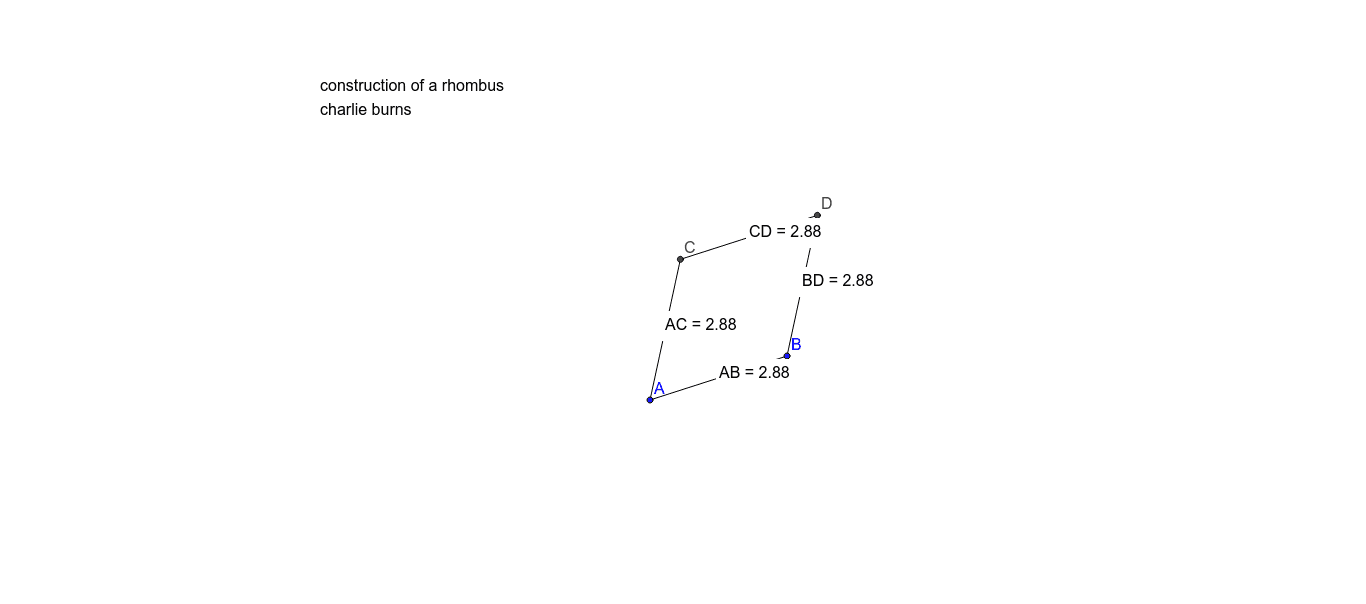
This example demonstrates how circles intersect to form a rhombus, highlighting geometric relationships between circles and polygons. Key mathematical concepts include circle equations, rhombus properties, and geometric construction techniques. Construction involves GeoGebra commands like Circle, Intersect, Segment, and Distance to locate rhombus vertices. Suitable for middle school students learning geometry fundamentals or for math teaching demonstrations.
GeoGebra Commands & Parameters
Circle(A, B) → cCircle(B, A) → dIntersect(c, d, 1) → CCircle(C, B) → eIntersect(d, e, 2) → DCircle(D, C) → fSegment(D, C) → aSegment(C, A) → bSegment(B, A) → gSegment(B, D) → hDistance(A, B) → distanceABDistance(B, D) → distanceBDMidpoint(B, D) →Distance(A, C) → distanceACMidpoint(A, C) →Distance(C, D) → distanceCDMidpoint(C, D) →
AI Drawing Prompt Reference
Draw a rhombus formed by two intersecting circles. The circles intersect at two points, which are the vertices of the rhombus. The sides of the rhombus are formed by connecting these vertices with line segments. The diagonals are the line segments connecting opposite vertices. Ensure the rhombus is symmetric and has equal side lengths.
The prompt above was compiled from the original drawing commands and is for reference only.