
Circle Reflection: Metric Space
Loading the math board and drawing, please wait…
In collections
Pythagoras
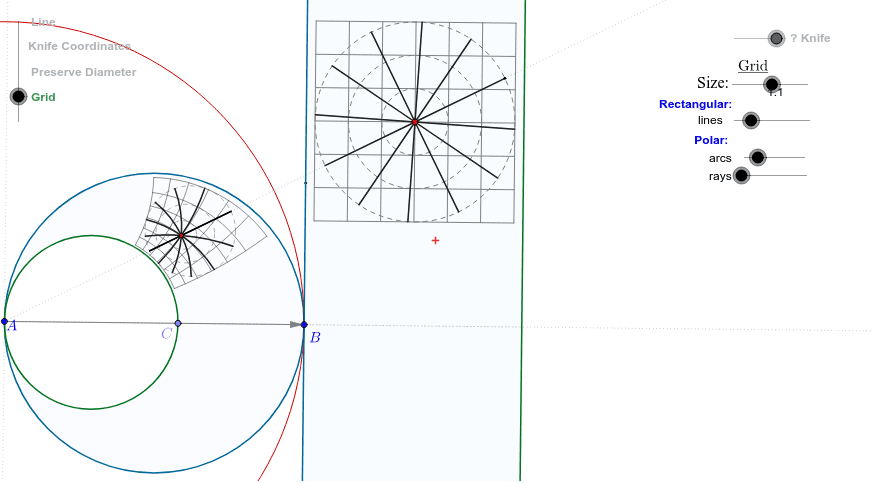
This example demonstrates the geometric transformation of inversion around a circle. Key math concepts include circle, reflection, metric space, trigonometry, and vectors. Construction involves commands like Segment, Point, Vector, Circle, Midpoint, UnitOrthogonalVector, Line, UnitVector, DynamicCoordinates, Intersect, Sequence, Mirror, Zip, Translate, Ray, Angle, If, and CircumcircleArc. Suitable for high school and above students to explore geometric transformations and metric space properties.
GeoGebra Commands & Parameters
Segment(A, B) → ABPoint(AB) → CSegment(A, C) → ACVector(A, B) → uCircle(A, A + v) → cMidpoint(B, C') → DSegment(B, D) → rVector(B, D) → wUnitOrthogonalVector(u) → v'Line(C', v') → gLine(B, z) → lUnitVector(u) → u'Line(B + prm * v', u') → g_2Point(Segment[Intersect[g_2, l], Intersect[g_2, g]]) → VDynamicCoordinates(O, x(V), y(V)) → WLine(W, u') → kIntersect(k, l) → TSegment(T, T + 2 * w) → tUnitVector(t) → t'Vector(A, L1) → aUnitVector(a) → l'Vector(H - L1) → v_1Vector(L1, L2) → w_1UnitVector(w_1) → z_1Line(O, u') → e_1Intersect(e_1, l) → T_1Sequence(k / n4, k, -n4, n4) → list5Midpoint(A, B) → M2Circle(M2, A) → k_1Point(k_1) → RIntersect(Ray[A, R], l) → SLine(D, v') → dSequence(m, m, -2 * n + 1, 2 * n - 1, 2) → n_jSequence(k, k, n0, n - 1) → n_iMidpoint(A, C) → M1Circle(M1, A) → fMirror(W, c) → L'_1Mirror(T_1, c) → P'Segment(A, C') → e_2Mirror(Z, c) → Z'Midpoint(A, Z') → GMirror(H, c) → H'Sequence(L1 - k / n3 * v_1, k, 1, n3) → RingA2Mirror(RingA2, c) → RingA1'Sequence(L1 + k / n3 * v_1, k, 1, n3) → RingA1Mirror(RingA1, c) → RingA2'Zip(Circle[Midpoint[a, b], a], a, RingA1, b, RingA2) → plrArcsZip(Circle[Midpoint[a, b], a], a, RingA1', b, RingA2') → plrArcs'Zip(S - z + (k + 1) * w, k, list5) → GridPtswZip(S + k * z, k, list5) → GridPtszZip(Midpoint[A, a], a, Mirror[Zip[S - u + k * z, k, list5], c]) → ringCenMirror(Grid1, c) → Grid1'Translate(Dilate[Grid1, EH / r, S - z], S' - S + z) → list1Mirror(list1, c) → list1'Mirror(GridPtsz, c) → GridPtsw'Zip(CircleArc[a, If[sgn((b - B) * v) ≥ 0, A, b], If[sgn((b - B) * v) ≥ 0, b, A]], a, ringCen, b, GridPtsw') → ringPartZip(Circle[a, A], a, ringCen) → ringFullLine(W, v') → h_1Mirror(h_1, c) → p_1Mirror(t, c) → t'_1Sequence(Rotate[H, k * 30 * ° / b_1, L1], k, 1, 12 * b_1) → plrPtsZip(Segment[L1, k], k, plrPts) → plrRad2Ray(L1, L2) → sdfMirror(L1, c) → L1'Segment(A, L1) → l_1Segment(A, B_1) → m_1Angle(L1, B_1, A) → αLine(A, v') → lineVLine(A, B) → lineUMirror(B_1, c) → FIf(v' ⊗ (L1 - B) ≥ 0, Intersect[l, sdf], L1) → LIntersect(g, sdf) → PSegment(L, P) → q_1Mirror(q_1, c) → s_1Midpoint(A, F) → QMirror(L2, c) → L2'Segment(A, L2) → t_1CircumcircleArc(L1', L2', A) → sdf'Circle(Q, L1') → c_2Segment(L1, B_1 - 0.25 * z_1) → r_1Segment(A, F) → a_2Ray(A, l') → b_2Angle(A, Z, W) → γSegment(A, Z) → f_2Mirror(Z, c) → Z'_1Intersect(Line[V, v'], lineU) → C_1Segment(A, T) → d_2Segment(A, T + 2 * w) → f_1Circle(Midpoint[A, Z'_1], A) → d_1Sequence(Rotate[H, (k * 30)°, L1], k, 1, 12) → plrPts2Zip(Segment[L1, k], k, plrPts2) → plrRad1Mirror(plrRad2, c) → plrRad2'Mirror(plrRad1, c) → plrRad1'Ray(L1, Vector[-z_1]) → i_2Zip(Ray[a + 2 * w, u'], a, GridPtsz) → list2Zip(Line[a + 2 * w, u'], a, GridPtsz) → list4Intersect(l, b_2) → UIntersect(b_2, g) → A_1Segment(U, A_1) → j_1Point(Ray[L1, l']) → D_1Mirror(k_2, c) → list6Segment(Mirror[E_1, c], Mirror[D_1, c]) → j_2Segment(Mirror[H, c], Mirror[2 * L1 - H, c]) → h_2Midpoint(t) → NZip(A + (1 - ε) / (1 + ((m + k2)^(2) - 1) * ε^(2)) * (u + (m + k2) * ε * v), m, n_j + 1) → CyclCenZip(A + (1 - ε) / (1 + (m + k2)^(2) * ε^(2)) * (u + (m + k2) * ε * v), m, n_j) → CyclPtsZip(Circle[a, b], a, CyclCen, b, CyclPts) → list3Segment(A, T_1) → c_1Point(CyclCen) → ESegment(E, Intersect[Ray[E, u'], d]) → eSegment(D - r / 2 * v', D + r / 2 * v') → p
AI Drawing Prompt Reference
Draw a circle and demonstrate geometric transformations around it. Start by creating a line segment and marking a point on it. Connect the start and this point with another line. Then, draw a circle centered at the start point with the end point as the radius. Find the midpoint and perpendicular line of the segment, and draw unit orthogonal vectors. Use these vectors to create lines and rays, identifying their intersections. Finally, apply mirror and reflection operations to showcase the circle's symmetry and geometric transformations, connecting relevant points with arcs to form a complete visual representation.
The prompt above was compiled from the original drawing commands and is for reference only.