
Chase Curve
Loading the math board and drawing, please wait…
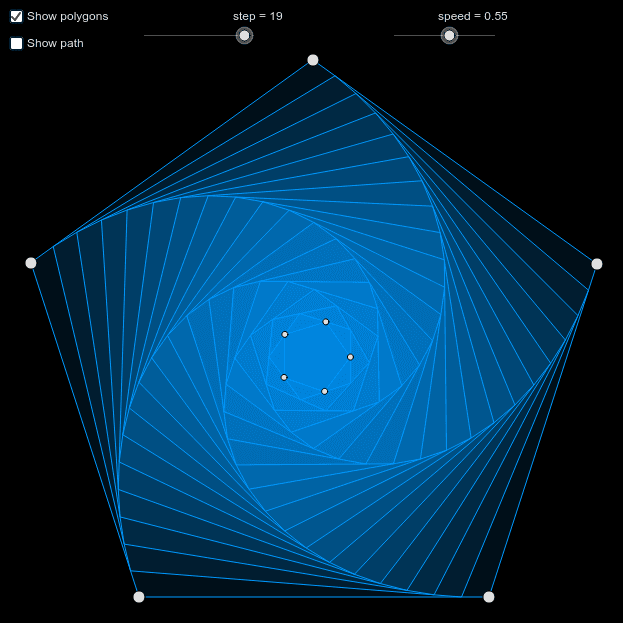
This example shows a dynamic pattern of five ants chasing each other. It demonstrates the concepts of vectors and geometric transformations. Using the Sequence and Polygon commands, you can observe how the ants move based on their speed and step. Suitable for middle school and above students to learn about geometric transformations and vectors.
GeoGebra Commands & Parameters
Sequence(Element[B1, Mod[i, 5] + 1] + (speed * UnitVector[Vector[Element[B1, Mod[i, 5] + 1], Element[B1, Mod[i + 1, 5] + 1]]]), i, 0, 4) → B2Sequence(Element[B2, Mod[i, 5] + 1] + (speed * UnitVector[Vector[Element[B2, Mod[i, 5] + 1], Element[B2, Mod[i + 1, 5] + 1]]]), i, 0, 4) → B3Sequence(Element[B3, Mod[i, 5] + 1] + (speed * UnitVector[Vector[Element[B3, Mod[i, 5] + 1], Element[B3, Mod[i + 1, 5] + 1]]]), i, 0, 4) → B4Sequence(Element[B4, Mod[i, 5] + 1] + (speed * UnitVector[Vector[Element[B4, Mod[i, 5] + 1], Element[B4, Mod[i + 1, 5] + 1]]]), i, 0, 4) → B5Sequence(Element[B5, Mod[i, 5] + 1] + (speed * UnitVector[Vector[Element[B5, Mod[i, 5] + 1], Element[B5, Mod[i + 1, 5] + 1]]]), i, 0, 4) → B6Sequence(Element[B6, Mod[i, 5] + 1] + (speed * UnitVector[Vector[Element[B6, Mod[i, 5] + 1], Element[B6, Mod[i + 1, 5] + 1]]]), i, 0, 4) → B7Sequence(Element[B7, Mod[i, 5] + 1] + (speed * UnitVector[Vector[Element[B7, Mod[i, 5] + 1], Element[B7, Mod[i + 1, 5] + 1]]]), i, 0, 4) → B8Sequence(Element[B8, Mod[i, 5] + 1] + (speed * UnitVector[Vector[Element[B8, Mod[i, 5] + 1], Element[B8, Mod[i + 1, 5] + 1]]]), i, 0, 4) → B9Sequence(Element[B9, Mod[i, 5] + 1] + (speed * UnitVector[Vector[Element[B9, Mod[i, 5] + 1], Element[B9, Mod[i + 1, 5] + 1]]]), i, 0, 4) → B10Sequence(Element[B10, Mod[i, 5] + 1] + (speed * UnitVector[Vector[Element[B10, Mod[i, 5] + 1], Element[B10, Mod[i + 1, 5] + 1]]]), i, 0, 4) → B11Sequence(Element[B11, Mod[i, 5] + 1] + (speed * UnitVector[Vector[Element[B11, Mod[i, 5] + 1], Element[B11, Mod[i + 1, 5] + 1]]]), i, 0, 4) → B12Sequence(Element[B12, Mod[i, 5] + 1] + (speed * UnitVector[Vector[Element[B12, Mod[i, 5] + 1], Element[B12, Mod[i + 1, 5] + 1]]]), i, 0, 4) → B13Sequence(Element[B13, Mod[i, 5] + 1] + (speed * UnitVector[Vector[Element[B13, Mod[i, 5] + 1], Element[B13, Mod[i + 1, 5] + 1]]]), i, 0, 4) → B14Sequence(Element[B14, Mod[i, 5] + 1] + (speed * UnitVector[Vector[Element[B14, Mod[i, 5] + 1], Element[B14, Mod[i + 1, 5] + 1]]]), i, 0, 4) → B15Sequence(Element[B15, Mod[i, 5] + 1] + (speed * UnitVector[Vector[Element[B15, Mod[i, 5] + 1], Element[B15, Mod[i + 1, 5] + 1]]]), i, 0, 4) → B16Sequence(Element[B16, Mod[i, 5] + 1] + (speed * UnitVector[Vector[Element[B16, Mod[i, 5] + 1], Element[B16, Mod[i + 1, 5] + 1]]]), i, 0, 4) → B17Sequence(Element[B17, Mod[i, 5] + 1] + (speed * UnitVector[Vector[Element[B17, Mod[i, 5] + 1], Element[B17, Mod[i + 1, 5] + 1]]]), i, 0, 4) → B18Sequence(Element[B18, Mod[i, 5] + 1] + (speed * UnitVector[Vector[Element[B18, Mod[i, 5] + 1], Element[B18, Mod[i + 1, 5] + 1]]]), i, 0, 4) → B19Sequence(Element[B19, Mod[i, 5] + 1] + (speed * UnitVector[Vector[Element[B19, Mod[i, 5] + 1], Element[B19, Mod[i + 1, 5] + 1]]]), i, 0, 4) → B20Polygon(B1) → C1, D1, E1, F1, G1, H1Polygon(B2) → C2, D2, E2, F2, G2, H2Polygon(B3) → C3, D3, E3, F3, G3, H3Polygon(B4) → C4, D4, E4, F4, G4, H4Polygon(B5) → C5, D5, E5, F5, G5, H5Polygon(B6) → C6, D6, E6, F6, G6, H6Polygon(B7) → C7, D7, E7, F7, G7, H7Polygon(B8) → C8, D8, E8, F8, G8, H8Polygon(B9) → C9, D9, E9, F9, G9, H9Polygon(B10) → C10, D10, E10, F10, G10, H10Polygon(B11) → C11, D11, E11, F11, G11, H11Polygon(B12) → C12, D12, E12, F12, G12, H12Polygon(B13) → C13, D13, E13, F13, G13, H13Polygon(B14) → C14, D14, E14, F14, G14, H14Polygon(B15) → C15, D15, E15, F15, G15, H15Polygon(B16) → C16, D16, E16, F16, G16, H16Polygon(B17) → C17, D17, E17, F17, G17, H17Polygon(B18) → C18, D18, E18, F18, G18, H18Polygon(B19) → C19, D19, E19, F19, G19, H19Polygon(B20) → C20, D20, E20, F20, G20, H20Sequence(Segment[Element[B2, i], Element[B1, i]], i, 1, 5) → I2Sequence(Segment[Element[B3, i], Element[B2, i]], i, 1, 5) → I3Sequence(Segment[Element[B4, i], Element[B3, i]], i, 1, 5) → I4Sequence(Segment[Element[B5, i], Element[B4, i]], i, 1, 5) → I5Sequence(Segment[Element[B6, i], Element[B5, i]], i, 1, 5) → I6Sequence(Segment[Element[B7, i], Element[B6, i]], i, 1, 5) → I7Sequence(Segment[Element[B8, i], Element[B7, i]], i, 1, 5) → I8Sequence(Segment[Element[B9, i], Element[B8, i]], i, 1, 5) → I9Sequence(Segment[Element[B10, i], Element[B9, i]], i, 1, 5) → I10Sequence(Segment[Element[B11, i], Element[B10, i]], i, 1, 5) → I11Sequence(Segment[Element[B12, i], Element[B11, i]], i, 1, 5) → I12Sequence(Segment[Element[B13, i], Element[B12, i]], i, 1, 5) → I13Sequence(Segment[Element[B14, i], Element[B13, i]], i, 1, 5) → I14Sequence(Segment[Element[B15, i], Element[B14, i]], i, 1, 5) → I15Sequence(Segment[Element[B16, i], Element[B15, i]], i, 1, 5) → I16Sequence(Segment[Element[B17, i], Element[B16, i]], i, 1, 5) → I17Sequence(Segment[Element[B18, i], Element[B17, i]], i, 1, 5) → I18Sequence(Segment[Element[B19, i], Element[B18, i]], i, 1, 5) → I19Sequence(Segment[Element[B20, i], Element[B19, i]], i, 1, 5) → I20
AI Drawing Prompt Reference
Draw a dynamic pattern of five ants chasing each other, demonstrating vector operations and geometric transformations. Each ant's position is calculated based on the previous ant's position and speed, using sequence commands to generate each step's position and polygon commands to connect these positions into paths. Finally, connect adjacent ant paths with line segments to show the chasing relationship.
The prompt above was compiled from the original drawing commands and is for reference only.