
Central and Axial Symmetry Transformations by Sinead Kenrick
Loading the math board and drawing, please wait…
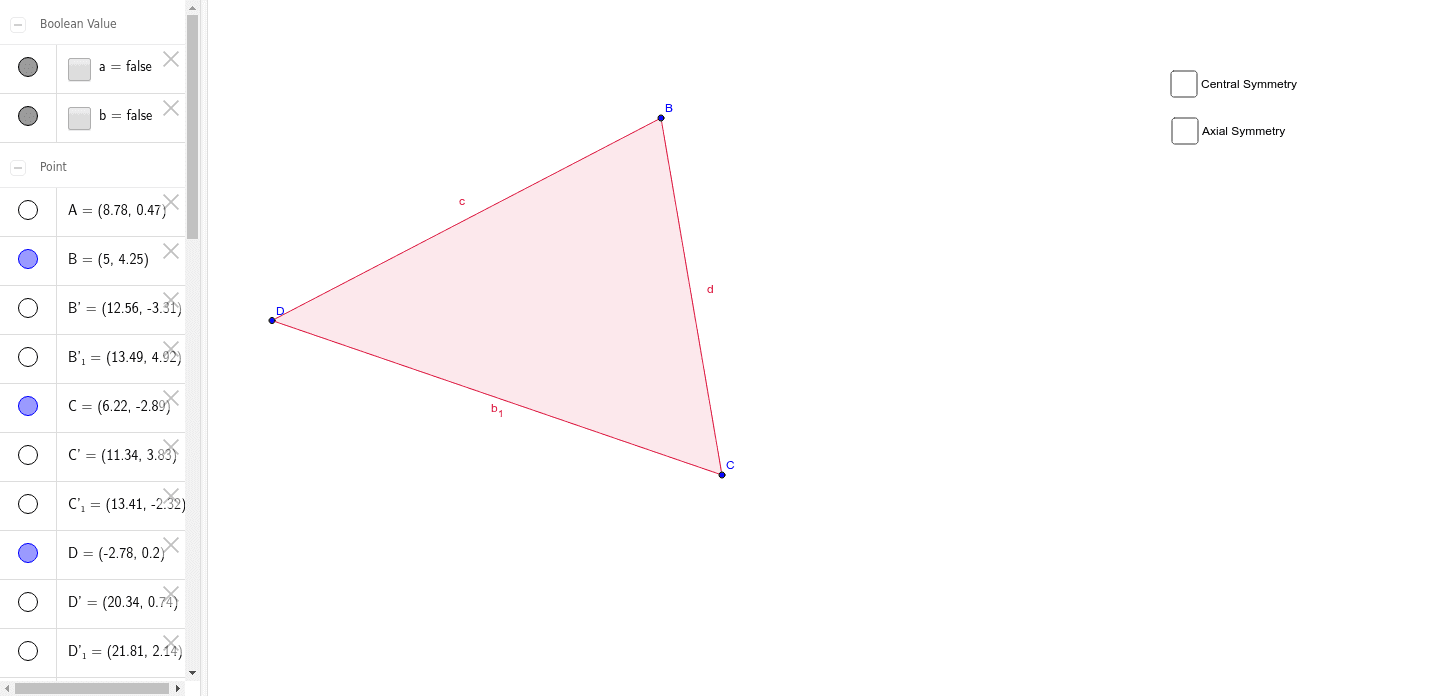
This example demonstrates the application of central and axial symmetry transformations in two-dimensional figures. It involves core mathematical concepts such as symmetry, vectors, line segments, and polygon construction. Key GeoGebra commands used include Polygon for drawing polygons, Mirror for symmetry, and Segment for line segments. Suitable for middle school and above students learning geometric transformations and vector concepts.
GeoGebra Commands & Parameters
Polygon(B, D, C) → poly1, c, b_1, dMirror(B, A) → B'Mirror(D, A) → D'Mirror(C, A) → C'Polygon(B', D', C') → poly1', c', b', d'Segment(C, C') → eSegment(B, B') → fSegment(D, D') → gSegment(E, F) → hMirror(B, h) → B'_1Mirror(D, h) → D'_1Mirror(C, h) → C'_1Polygon(B'_1, D'_1, C'_1) → poly1'_1, c'_1, b'_1, d'_1Segment(B, B'_1) → iSegment(C, C'_1) → jSegment(D, D'_1) → k
AI Drawing Prompt Reference
Draw a triangle ABC, then perform axial symmetry transformations with point A as the center for points B, C, and D to get B', C', and D', and draw a new triangle B'C'D'. Next, draw line segments from B to B', C to C', and D to D'. Finally, draw a line segment EF, perform axial symmetry transformations with E as the center for B and D to get B'_1 and D'_1, and with F as the center for C to get C'_1, and draw a new triangle B'_1D'_1C'_1.
The prompt above was compiled from the original drawing commands and is for reference only.