
Cavalieri's Principle & Volume of a Sphere v2
Loading the math board and drawing, please wait…
In collections
CCSS G-GMD Geometric Measurement and Dimension
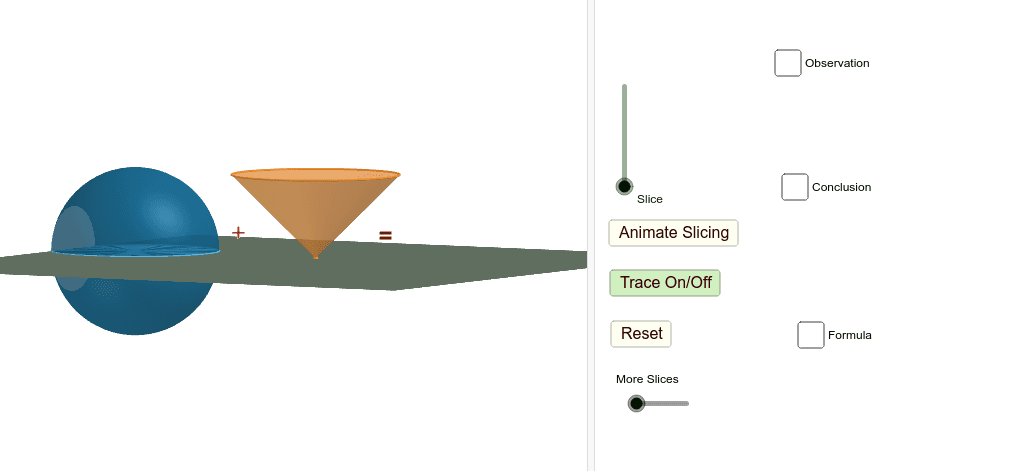
This interactive GeoGebra applet demonstrates how to compute the volume of a sphere using Cavalieri's Principle. The core mathematical idea is that if two solids have equal cross-sectional areas at every height, their volumes are equal. The applet compares a sphere with an auxiliary solid (a cylinder with a cone removed) and shows that their horizontal slices have equal areas, leading to the classic formula V = (4/3)πr³. Construction details include the use of GeoGebra commands such as Point, Line, OrthogonalLine, Sphere, Cone, Plane, IntersectPath, Center, Segment, and Circle. Key objects include the sphere center O, radius r, the auxiliary cylinder and cone, multiple cross-section circles and paths, plus interactive buttons (button1/2/3) and trace objects for dynamic visualization. This resource is ideal for high school or early college students learning solid geometry, volume derivation, and the transition from geometric intuition to integral calculus.
GeoGebra Commands & Parameters
Point(xAxis) → ALine(A, O) → b_1Point(xAxis) → FOrthogonalLine(A, xOyPlane) → bLine(F, b) → jSphere(O, r) → aPoint(b) → BCone(B, C, r) → c, d, ePlane(G, xOyPlane) → fIntersectPath(f, a) → gIntersectPath(f, c) → hPlane(O, xOyPlane) → iPlane(O, xOyPlane) → lCenter(h) → HCenter(g) → IPoint(g) → JPoint(h) → KSegment(I, J) → mSegment(H, K) → nPoint(xAxis) → MPoint(xAxis) → NCircle(X, n, zAxis) → c_1Center(c_1) → LCenter(c_1) → xxCircle(xx, rr, b) → sPoint(b_1) → DOrthogonalLine(D, xOyPlane) → tPoint(t) → EPoint(b_1) → POrthogonalLine(P, xOyPlane) → a_1Point(a_1) → Q