
Campbell's Test: Maximizing Volume of a Cylinder with Fixed Surface Area
Loading the math board and drawing, please wait…
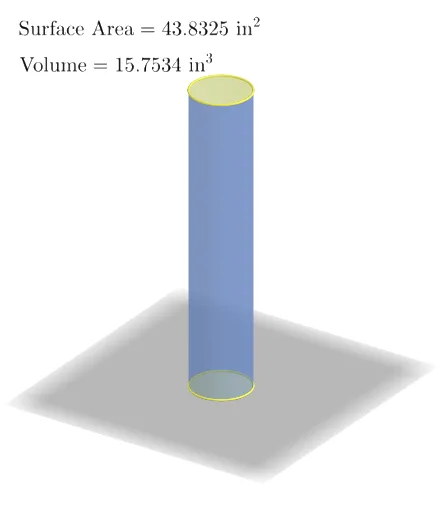
This GeoGebra example dynamically demonstrates the classic optimization problem of finding the dimensions that maximize the volume of a cylinder when its surface area is fixed. The core mathematical concepts involve calculus (derivatives and extrema) and solid geometry (surface area and volume formulas for a cylinder). The construction uses commands such as Circle to create the base, Cylinder to generate the 3D solid, Volume to compute the volume, Intersect to find key points, and Textfield/InputBox for interactive input. Users can adjust the radius r and height h via sliders or input boxes, observing how the volume V and its derivative V' change in real time. This is suitable for high school or introductory college calculus students, helping them understand the application of derivatives in optimization, and can also serve as a real-world modeling activity (e.g., can design).
GeoGebra Commands & Parameters
Circle(A, B, xOyPlane) → cCylinder(c, a) → b, d, eVolume(b) → fIntersect(V, xAxis, 3) → EIntersect(V', xAxis, 2) → FIntersect(h, i) → GTextfield(r) → InputBox1