
Calculating Rectangle Area
Loading the math board and drawing, please wait…
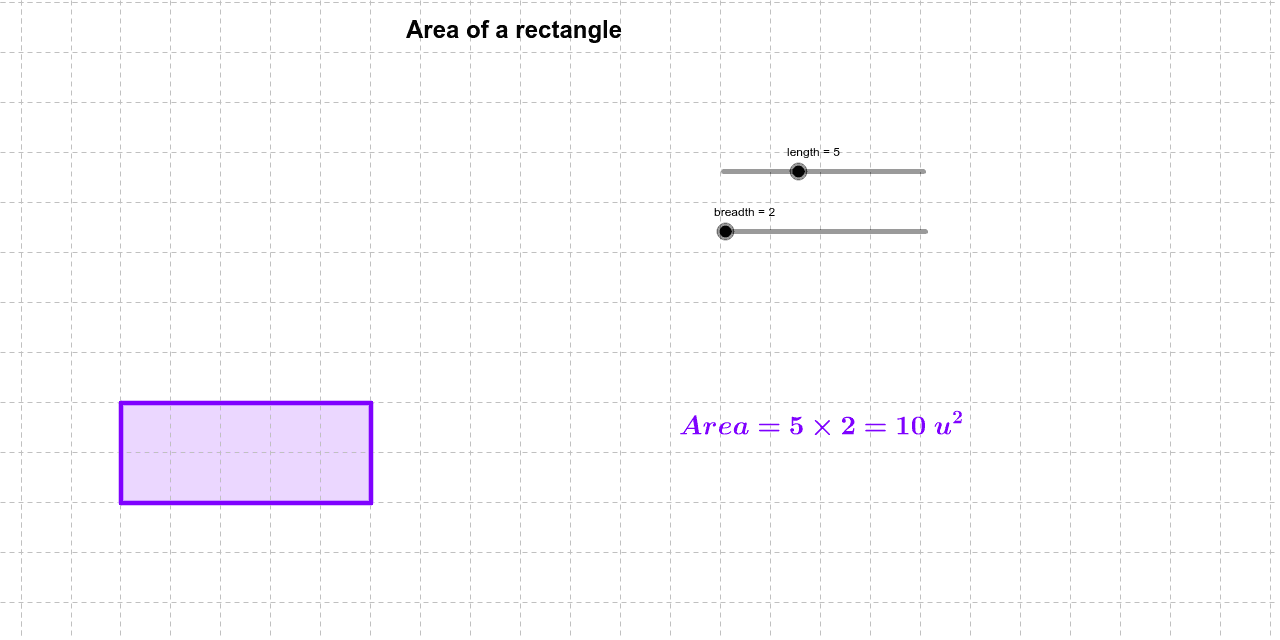
This example demonstrates how to dynamically calculate the area of a rectangle using GeoGebra. It covers core concepts like rectangle definition, length-width relationship, area formula, and multiplication principle. Constructed with commands such as Point, Segment, Circle, OrthogonalLine, Intersect, Line, Polygon, it is suitable for middle school mathematics teaching to help students visually understand the area formula and its application.
GeoGebra Commands & Parameters
Point(Circle[A, length]) → BSegment(A, B) → aCircle(A, breadth) → cOrthogonalLine(A, a) → bIntersect(c, b) → C, DLine(D, a) → dLine(B, b) → eIntersect(d, e) → EPolygon(A, D, E, B) → poly1, a_1, d_1, e_1, b_1
AI Drawing Prompt Reference
Draw a rectangle by first creating a line segment, then using one endpoint as a center and the other segment length as a radius to draw a circle. Next, draw a line perpendicular to the initial segment from the center point, intersecting the circle at two points. Connect these intersection points to the other endpoint of the initial segment to form the rectangle, showing all sides and vertices.
The prompt above was compiled from the original drawing commands and is for reference only.