
Calculate the Volume of a Cylinder
Loading the math board and drawing, please wait…
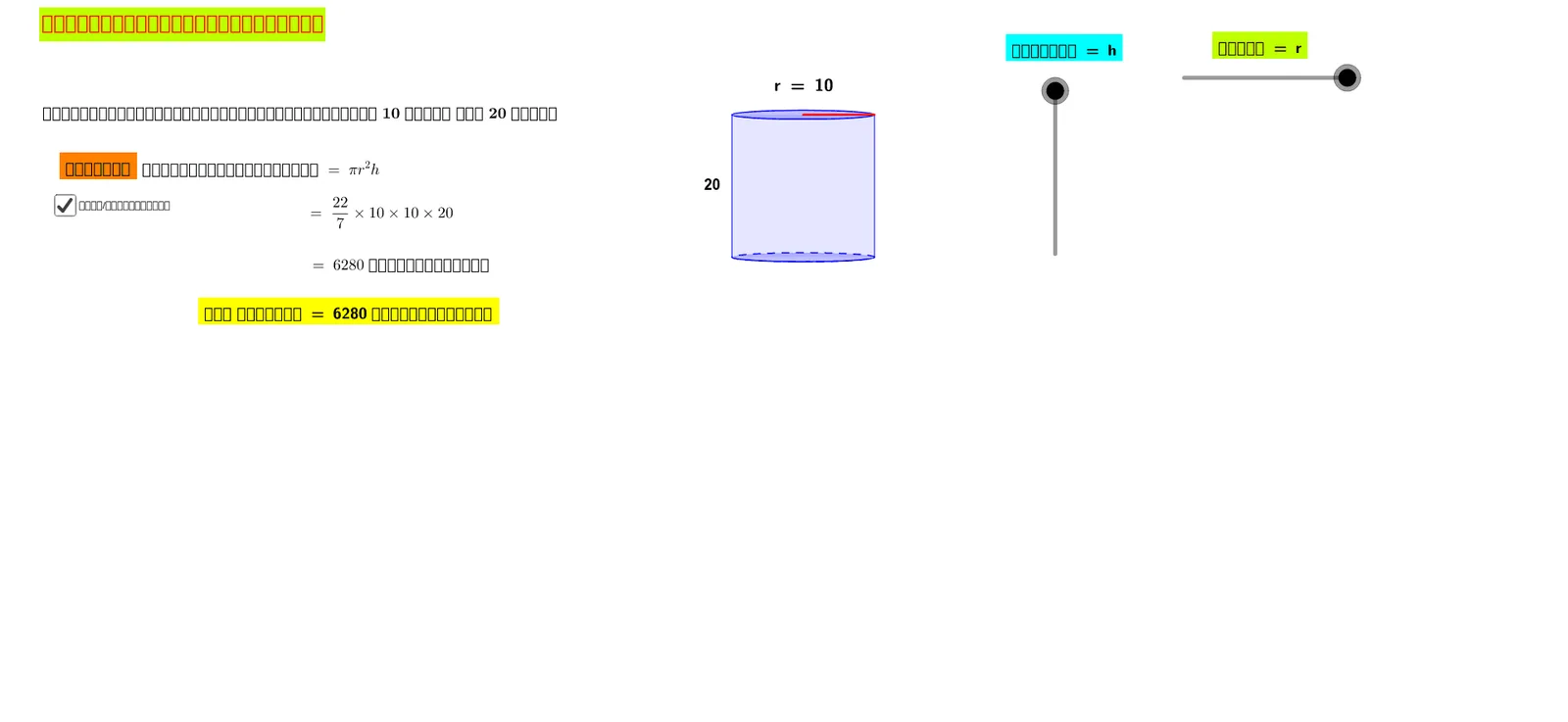
This example demonstrates how to calculate the volume of a cylinder using geometric construction. Key mathematical concepts include the volume formula of a cylinder. Using GeoGebra commands such as Intersect, Vector, Translate, etc., the construction process of the cylinder is dynamically displayed. Suitable for middle school and above students to learn geometry and volume calculation.
GeoGebra Commands & Parameters
Intersect(c, xAxis, 1) → AIntersect(c, xAxis, 2) → BVector((-17, 0), (-17, b)) → uTranslate(c, u) → dTranslate(A, u) → CTranslate(B, u) → DSegment(A, C) → eSegment(B, D) → fArc(c, A, B) → gPolygon(C, D, B, A) → P, c_1, d_1, b_1, a_1Intersect(xAxis, yAxis) → ESegment(E, B) → hTranslate(E, u) → E'Translate(B, u) → B'Segment(E', B') → iRoot(32) → FMidpoint(i) → GMidpoint(e) → H
AI Drawing Prompt Reference
Draw a cylinder by first creating a circle c, then finding the two intersection points A and B of the circle c with the x-axis. Draw a vertical vector u from the x-axis, and translate the circle c and points A and B along vector u to get circle d and points C and D. Connect points A and C, and B and D to form line segments e and f. Use points A and B to draw an arc g, and then use points C, D, B, and A to form a quadrilateral P.
The prompt above was compiled from the original drawing commands and is for reference only.