
By all means! - Averaging 3 Numbers
Loading the math board and drawing, please wait…
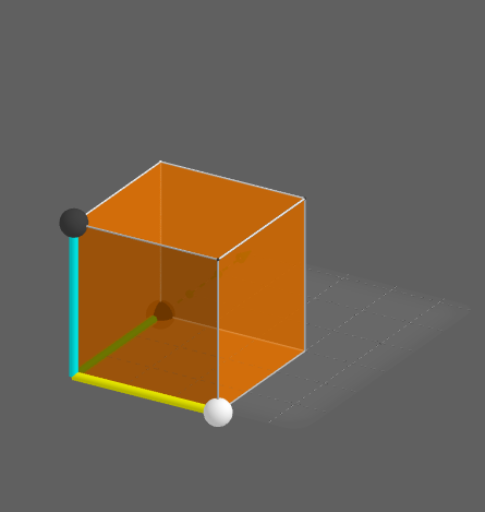
This GeoGebra example demonstrates the concept of averaging three numbers through a vivid three-dimensional geometric construction. It visualizes how arithmetic and geometric means can be represented using spatial objects such as points, segments, cubes, and polygons, while incorporating trigonometric functions and geometric transformations. The core mathematical ideas include mean values, cosine functions, and spatial transformations. The construction uses GeoGebra commands like Point, Segment, Cube, and Polygon, with numerous auxiliary objects (X, Y, Z, O, A, B, C, D, etc.) to build a dynamic model that illustrates the averaging process. Suitable for middle school to undergraduate students, this interactive tool helps learners grasp the geometric interpretation of averages and explore the relationship between numbers and shapes in a hands-on manner.
GeoGebra Commands & Parameters
Point(xAxis) → XPoint(yAxis) → YPoint(zAxis) → ZSegment(O, X) → fSegment(X, B) → gSegment(B, Z) → hSegment(Z, O) → iSegment(O, Y) → jSegment(Y, A) → kSegment(A, X) → lSegment(X, O) → mSegment(Z, C) → nSegment(C, D) → pSegment(D, B) → qSegment(C, Y) → rSegment(D, A) → sPoint(Circle[E, Distance[O, E], Segment[O, E]]) → FPoint(Circle[G, Distance[O, G], Segment[O, G]]) → HCube(O, G, H) → a, I, faceHIML, faceJKLM, edgeIO, edgeGO, edgeGH, edgeHI, edgeJO, edgeIM, edgeJM, edgeJK, J, edgeGK, edgeKL, edgeHL, edgeLM, K, L, M, faceGHIO, faceIMJO, faceGKJO, faceGHLKSegment(Q, S) → tSegment(S, N) → bSegment(N, O) → cSegment(O, Q) → dSegment(N, R) → eSegment(Y, O) → g_1Segment(O, N) → h_1Segment(R, T) → i_1Segment(T, S) → j_1Segment(U, Q) → l_1Segment(U, T) → m_1Segment(U, P) → f_1Segment(P, R) → k_1Segment(Z, O) → n_1Segment(O, Z) → p_1Segment(O, Q) → q_1Segment(O, Z) → r_1Polygon(V, W, D_1, C_1) → poly1, v, w, d_1, c_1Polygon(W, A_1, E_1, D_1) → poly2, w_1, a_1, e_1, d_2Polygon(A_1, B_1, F_1, E_1) → poly3, a_2, b_1, f_2, e_2Point(s_1) → H_1Polygon(H_1, J_1, F_1, K_1) → poly4, h_2, j_2, f_3, k_2Polygon(K_1, H_1, I_1, C_1) → poly5, k_3, h_3, i_2, c_2Segment(H_1, (x(H_1), 0)) → t_1