
Box Folding for Maximum Volume by Banharn Katkasam
Loading the math board and drawing, please wait…
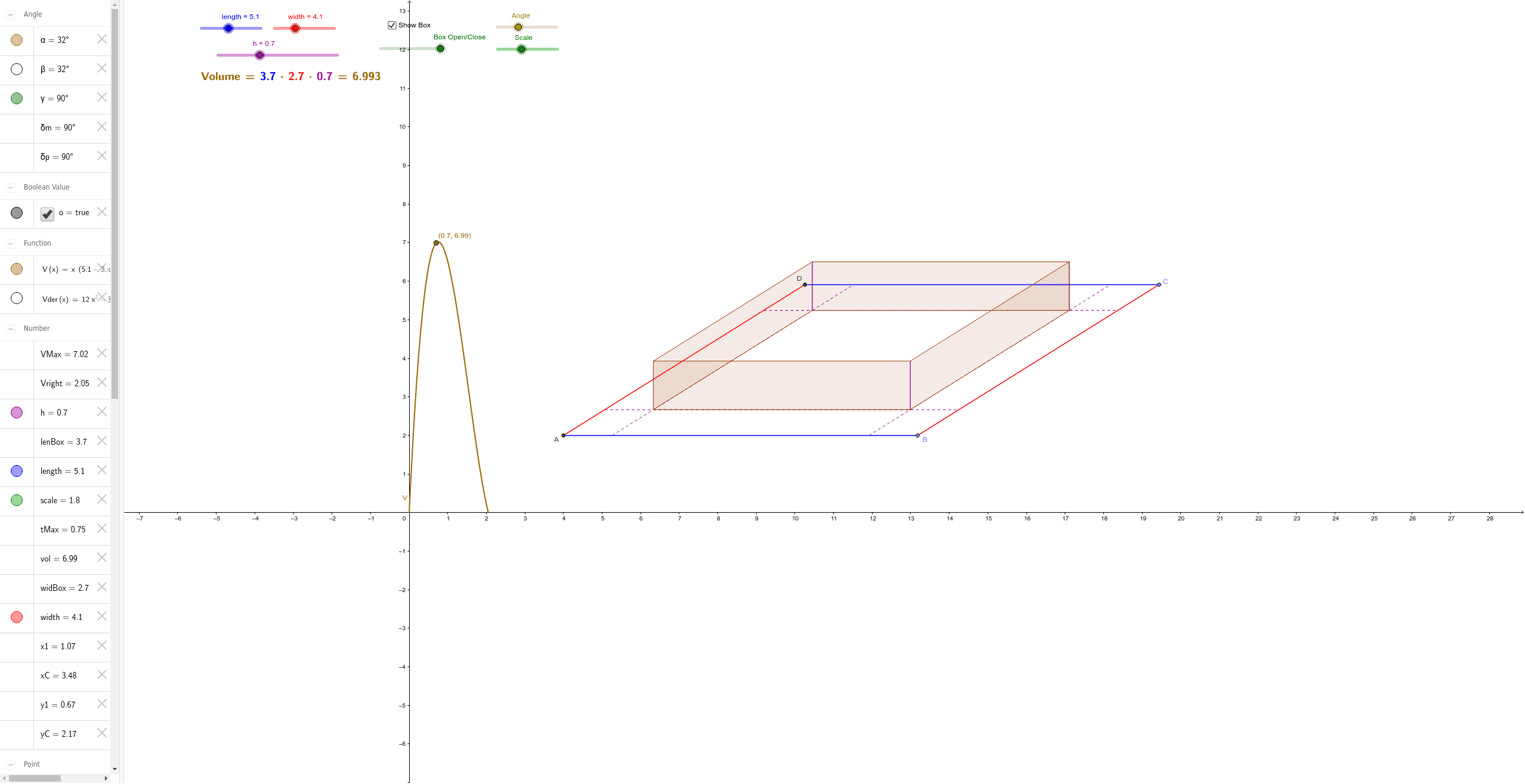
This example demonstrates how to find the maximum volume of a box by folding. Key mathematical concepts include volume calculation in solid geometry and the use of derivatives in calculus. Using GeoGebra commands such as Function, Segment, Rotate, Line, and Intersect, the dynamic transformation and volume changes during the folding process are illustrated. Suitable for high school mathematics education, particularly in solid geometry and calculus.
GeoGebra Commands & Parameters
Function(((x * (length - (2 * x))) * (width - (2 * x))), 0, Vright) → VSegment(B, C) → bRotate(B, α, A) → B'Line(B', A) → sLine(Ax, s) → s1Segment(A, B) → aLine(C, a) → rIntersect(s, r) → DLine(Dy, r) → r1Intersect(r1, b) → CySegment(Dy, Cy) → c1Segment(C, D) → cIntersect(s1, c) → DxSegment(Ax, Dx) → d1Intersect(d1, c1) → D1Line(B, s) → qLine(Bx, q) → q1Intersect(q1, c) → CxSegment(Bx, Cx) → b1Intersect(b1, c1) → C1Line(A, B) → pLine(Ay, p) → p1Intersect(p1, b) → BySegment(Ay, By) → a1Intersect(d1, a1) → A1Intersect(b1, a1) → B1Angle(B, A, B') → βSegment(D, A) → dPolygon(A1, A2a, B2a, B1) → poly1, e, f, g, h_1Polygon(B1, B2b, C2b, C1) → poly2, i, j, k, lPolygon(C1, C2c, D2c, D1) → poly3, c_1, d_1, e_1, f_1Polygon(D1, D2d, A2d, A1) → poly4, m, n, a_1, b_1Derivative(V) → VderRoot(Vder) → tMax_1, tMax_2Min(x(tMax_1), x(tMax_2)) → tMaxSegment(tMax_1, P) → g_1