
Boat Coordinate Game by Markus Hohenwarter (2)
Loading the math board and drawing, please wait…
In collections
Games
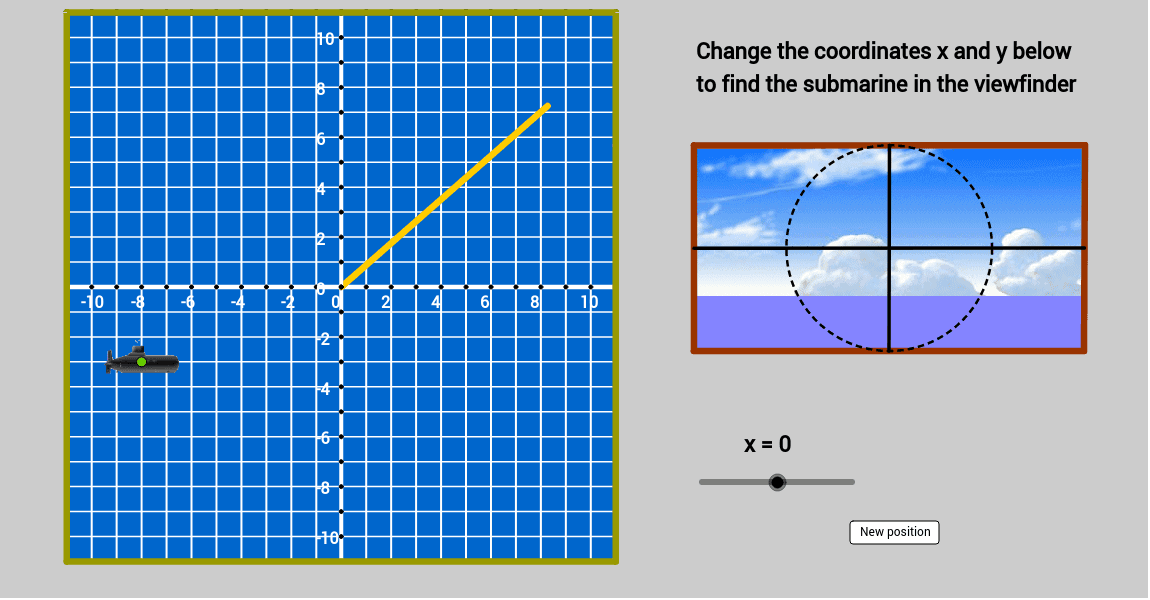
Find the submarine to practice coordinates. This adaptation of the original game by Daniel Mentrard is optimized for tablets. The example demonstrates the use of various GeoGebra commands such as Random, Circle, Ray, OrthogonalLine, Intersect, CircumcircleArc, Midpoint, Sequence, If, Segment, Polygon, Rotate, Mod, Point. Suitable for middle school and above students to practice coordinate geometry.
GeoGebra Commands & Parameters
Random(-10, 10) → bbRandom(-10, 10) → aaRandom(-10, 10) → ccRandom(4, 15) → rrCircle(A, (1.5 * v - 1) * rr) → c'Ray(A, (0, 0)) → aOrthogonalLine(A, a) → bIntersect(c', b) → B, CIntersect(c', a) → D, TCircumcircleArc(B, D, C) → dMidpoint(C, D) → EMidpoint(B, D) → F_2Ray(A', E) → eRay(A', F_2) → fIntersect(d, e) → G,Intersect(d, f) → H,CircumcircleArc(G, D, H) → gCircle(I, 1) → hSequence(Text[If[s < 10, " ", ""] + (s), (21.6 + 2 * Mod[s - 1, 3], 7.75 - 2 * Div[s - 1, 3])], s, 1, 12) → liste3Circle(J, 1) → kSequence(Text[If[s ≟ 1, " ", If[s < 5, " ", ""]] + (30 * (s - 1)) + "º", (21.25 + 2 * Mod[s - 1, 3], -6.25 - 2 * Div[s - 1, 3])], s, 1, 12) → liste4If(yB > -5, 5*°, (((xB - 3 * yB) / 2 - 19 - 1) * 30)°) → angIf(ang ≟ α ∧ dist ≟ rr, true, false) → razSegment(O, N) → mCircle(A, (2 * v - 1) * rr - n) → pSequence(Circle[A, (1.5 * v - 1) * rr - i], i, 0, n, n / 10) → liste5Polygon(P, Q, R, S) → poly1, p_1, q, r_1, sCircle((0, 0), If[2 * v * rr > 12, 0, 2 * v * rr]) → cMidpoint(K, L) → UMidpoint(U, L) → VMidpoint(U, V) → WMidpoint(V, L) → ZSegment(K, C_1) → lLine(A, l) → iSegment(A, U) → tIntersect(c, t) → A_1, B_1Segment(U, A_1) → a_1Rotate(C_1, 6 * v, U) → L'Segment(U, L') → b_1Mod(v * 100, 2) → abSegment(O, D_1) → jCircle(O, C_1) → g_1Point(g_1) → E_1Segment(O, E_1) → h_1Circle(F_1, 6.5 - abs(r / 4.5)) → q_1Line(F_1, l) → i_1Intersect(q_1, i_1) → G_1, H_1Line(J_1, r_1) → j_1Point(j_1) → N_1Line(N_1, l) → l_1Line(J_1, l) → m_1Point(m_1) → O_1Point(l_1) → P_1Intersect(l_1, r_1) → M_1Polygon(M_1, N_1, J_1, F) → poly2, m_2, n_1, j_2, f_2Point(l_1) → Q_1Point(m_1) → R_1Polygon(P_1, Q_1, R_1, O_1) → poly3, p_2, q_2, r_2, o_1Point(j_1) → S_1Polygon(S_1, T_1, O_1, J_1) → poly4, s_1, t_1, o_2, j_3Midpoint(s_1) → V_1Midpoint(o_2) → W_1Midpoint(S_1, J_1) → Z_1Midpoint(t_1) → A_2Segment(V_1, W_1) → a_2Segment(Z_1, A_2) → b_2Intersect(b_2, a_2) → B_2Circle(B_2, V_1) → c_2Sequence((x(O) + i, y(D_1)), i, -11, 11, 1) → liste1Sequence((x(N) + i, y(N)), i, -11, 11, 1) → liste6Sequence((x(C_1), y(C_1) + i), i, -11, 11, 1) → liste7Sequence((x(E_1), y(E_1) + i), i, -11, 11, 1) → liste8Ray(M_1, T_1) → c_1Sequence(Segment[Element[liste8, i], Element[liste7, i]], i, 0, 22) → liste10Sequence((x(D_1) + i, 0), i, -11, 11) → liste2Sequence(Segment[Element[liste1, i], Element[liste6, i]], i, 0, 22) → liste9Line(S, P) → d_1Line(J_1, S_1) → e_1Line(Q_1, e_1) → f_1Intersect(d_1, s) → MIntersect(d_1, f_1) → C_2Line(R, d_1) → k_1Intersect(e_1, k_1) → D_2Polygon(S, C_2, Q_1, S_1, D_2, R) → poly5, s_2, c_3, q_3, s_3, d_2, r_3Point(d_1) → E_2Line(E_2, p_1) → e_2Intersect(k_1, e_2) → G_2Polygon(E_2, P, Q, G_2) → poly6, e_3, p_3, q_4, g_2Sequence(O + (i, 0), i, -10, 10) → liste11Sequence(O + (0, i), i, -10, 10) → liste12Sequence(i, i, -10, 10) → liste13Sequence(Text[Element[liste13, i], (x(Element[liste11, i] - 0.42), y(Element[liste11, i] - 0.85))], i, 1, Length[liste13], 2) → liste14Sequence(Text[Element[liste13, i], (x(Element[liste12, i] - 1), y(Element[liste12, i] - 0.31))], i, 1, Length[liste13], 2) → liste15
AI Drawing Prompt Reference
Draw a coordinate-based submarine treasure hunt game. Start by randomly generating the coordinates of the submarine A, then draw a circle c' centered at A. Draw a ray a from A and its perpendicular line b, intersecting c' at points B and C. Draw circle d, and find the midpoints E and F of segments BD and DC, then draw rays e and f, intersecting d at points G and H. Draw circle g, and a unit circle h. Finally, based on angle and distance conditions, draw a series of circles and segments to form a complex geometric figure.
The prompt above was compiled from the original drawing commands and is for reference only.