
Black Hole Model: Geometric Visualization with Cones, Spheres, and Rotation
Loading the math board and drawing, please wait…
In collections
PAPAS^3 Curriculum in Space Science
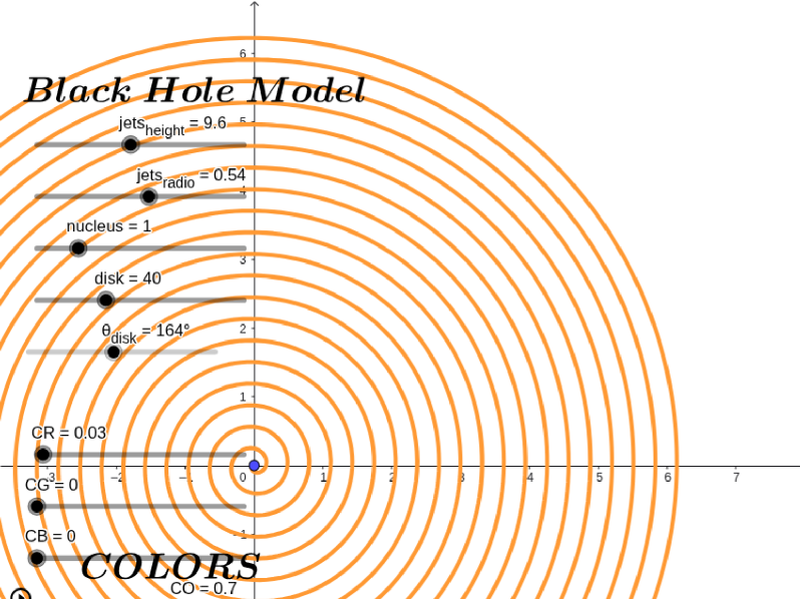
① This GeoGebra example constructs a 3D black hole model, visually demonstrating the accretion disk, jets, and core structure. ② Core mathematical concepts include solid geometry (cones, spheres, solids of revolution), parametric equations (CurveCartesian), and differential equations (as tagged), along with circles, right triangles, and rational numbers. ③ Construction highlights: uses CurveCartesian for curves, Cone for jet cones, Sphere for the nucleus, and Rotate for rotational symmetry; key objects include nucleus, jets_height, disk, θ_disk, and sliders (a, θ_disk) for dynamic adjustment. ④ Suitable for high school to university-level mathematics or physics teaching, illustrating 3D geometric modeling, parametric equations, and rotational solids, and serving as an interdisciplinary visualization bridging math and astrophysics.
GeoGebra Commands & Parameters
CurveCartesian((t / 20 * cos(t)), (t / 20 * sin(t)), 0, t, 0, (disk * π)) → aCone((0, 0, jets_{height}), (0, 0, 0), jets_{radio}) → l, p, mCone((0, 0, (-jets_{height})), (0, 0, 0), jets_{radio}) → b, b_2, b_3Rotate(a, θ_{disk}, A) → a'Sphere(A, C) → j