
Bivariate Normal Distribution 3D Surface and Tangent Plane
Loading the math board and drawing, please wait…
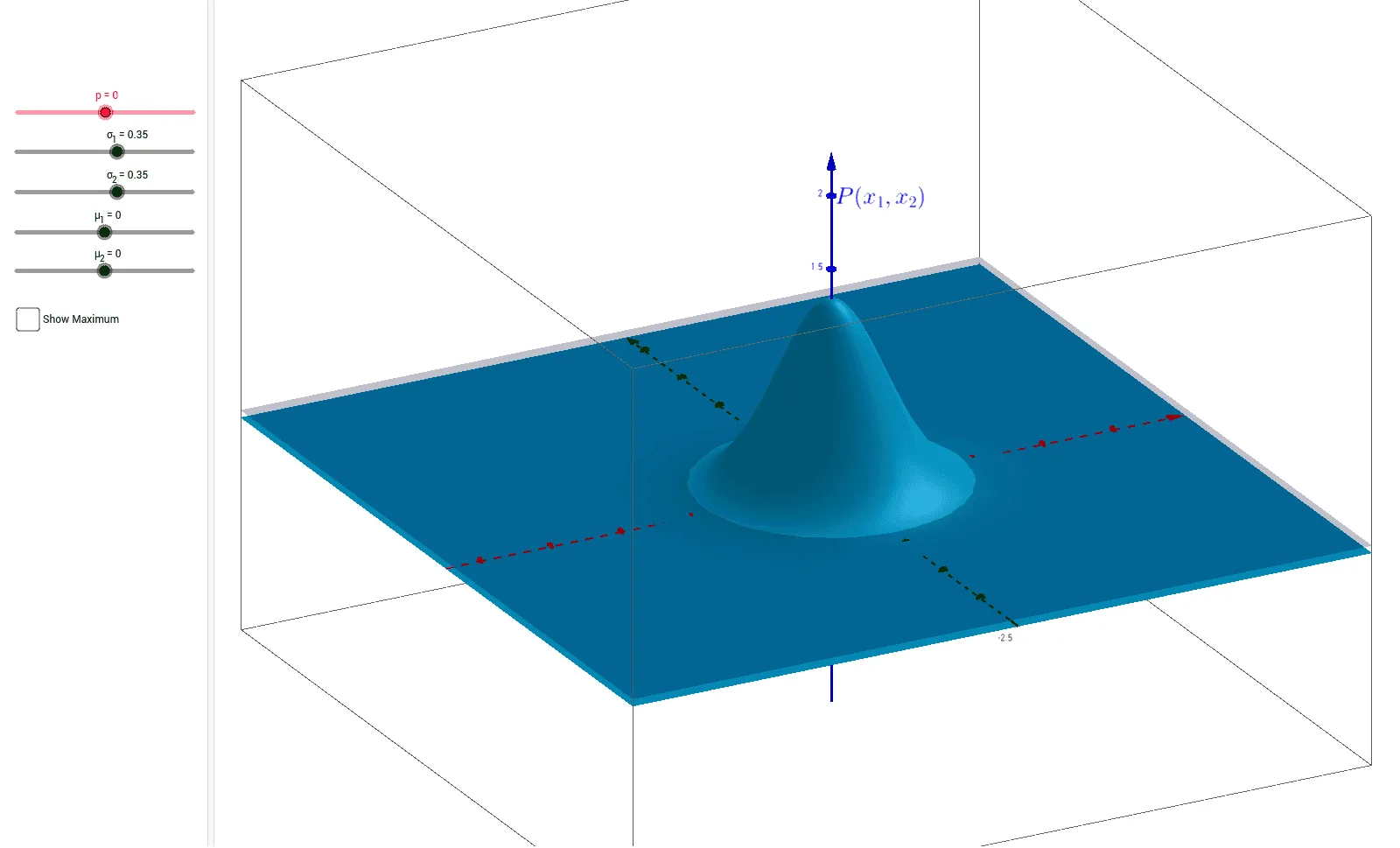
This GeoGebra example demonstrates the 3D probability density surface of a bivariate normal distribution and its geometric features. Core mathematical concepts include multivariate normal distribution, covariance matrix, mean vector, probability density function, maximum point on the surface, and tangent plane. Construction details: using GeoGebra commands, parameters p (correlation coefficient), σ_1, σ_2 (standard deviations), μ_1, μ_2 (means), Coeff (normalization coefficient), Denom (denominator expression), d and b (for constructing the tangent plane) are created, along with Maximum and Max to compute the surface maximum, and text1 to text4 for labeling key points and formulas. This example is suitable for university-level probability and statistics, multivariate analysis, or advanced calculus courses to understand the shape of bivariate normal distributions, parameter effects, and the geometric meaning of tangent planes. It can also be used for classroom demonstrations or student exploration.
GeoGebra Commands & Parameters
Numeric p(0.0)Numeric σ_1(0.35)Numeric σ_2(0.35)a:1 / ((2 * π))1 / (((((2 * π) * σ_1) * σ_2) * sqrt(1 - p^(2))))Numeric μ_1(0.0)Numeric μ_2(0.0)-1 / ((2 * (1 - p^(2))))d(x, y) = (Coeff * ℯ^((Denom * ((x - μ_1)^(2) / σ_1^(2) - (((2 * p) * (x - μ_1)) * (y - μ_2) / ((σ_1 * σ_2))) + (y - μ_2)^(2) / σ_2^(2)))))b:z = 0.05(μ_1, μ_2, Coeff)Boolean Max(false)
AI Drawing Prompt Reference
Draw a 3D probability density surface of a bivariate normal distribution and add a tangent plane. First, set the correlation coefficient p to 0.0, and the standard deviations σ1 and σ2 to 0.35, with means μ1 and μ2 both at 0.0. Then, calculate the coefficient Coeff and the denominator Denom, and use these parameters to construct the surface equation d(x, y). Select a point (μ1, μ2, Coeff) on the surface as the reference point for the tangent plane, and set the height of the tangent plane to 0.05.
The prompt above was compiled from the original drawing commands and is for reference only.