
Bezier Curve: Dynamic Construction and Geometric Visualization
Loading the math board and drawing, please wait…
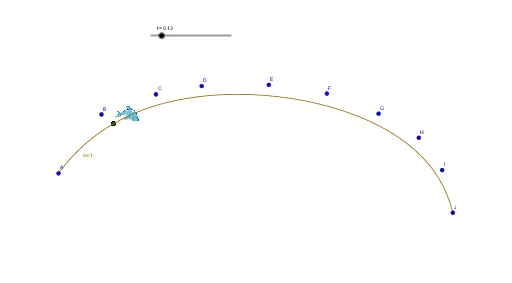
This GeoGebra example dynamically demonstrates the construction of a Bezier curve, showing how a parametric curve defined by control points is generated through recursive linear interpolation, gradually forming a smooth path. The core mathematical concepts include parametric equations, control points, Bernstein polynomials, and the notion of locus, with related topics such as geometric mean, right triangles, and fractal geometry. The construction uses the Segment command to connect control points, Sequence to generate point series, and Locus to trace the moving point's path, ultimately producing the Bezier curve; objects include control points A, B, C, etc., and auxiliary segments and loci like f, g. This example is suitable for high school to undergraduate students learning analytic geometry, parametric curves, or introductory computer graphics, and also serves as a teaching tool for instructors to illustrate curve construction principles and interactive parametric modeling.
GeoGebra Commands & Parameters
Segment(A, B) → fSegment(B, C) → gSegment(C, D) → hSegment(D, E) → iSegment(E, F) → jSegment(F, G) → kSegment(G, H) → lSegment(H, I) → mSegment(I, J) → nSegment(B_1, C_1) → pSegment(C_1, D_1) → qSegment(D_1, E_1) → rSegment(E_1, F_1) → sSegment(F_1, G_1) → aSegment(G_1, H_1) → bSegment(H_1, I_1) → cSegment(A_1, B_1) → dSegment(A_2, B_2) → eSegment(B_2, C_2) → f_1Segment(C_2, D_2) → g_1Segment(D_2, E_2) → h_1Segment(E_2, F_2) → i_1Segment(F_2, G_2) → j_1Segment(G_2, H_2) → k_1Segment(A_3, B_3) → l_1Segment(B_3, C_3) → m_1Segment(C_3, D_3) → n_1Segment(D_3, E_3) → p_1Segment(E_3, F_3) → q_1Segment(F_3, G_3) → r_1Segment(A_4, B_4) → s_1Segment(B_4, C_4) → t_1Segment(C_4, D_4) → a_1Segment(D_4, E_4) → b_1Segment(E_4, F_4) → c_1Segment(A_5, B_5) → d_1Segment(B_5, C_5) → e_1Segment(C_5, D_5) → f_2Segment(D_5, E_5) → g_2Segment(A_6, B_6) → h_2Segment(B_6, C_6) → i_2Segment(C_6, D_6) → j_2Segment(A_7, B_7) → k_2Segment(B_7, C_7) → l_2Segment(A_8, B_8) → m_2Locus(A_9, t) → loc1Sequence((x(A_9), y(A_9)), t, x(A), x(J)) → list1