
BED Electrical Meter Solution
Loading the math board and drawing, please wait…
In collections
Rate & Accumulation Yr 4 Much&Fast
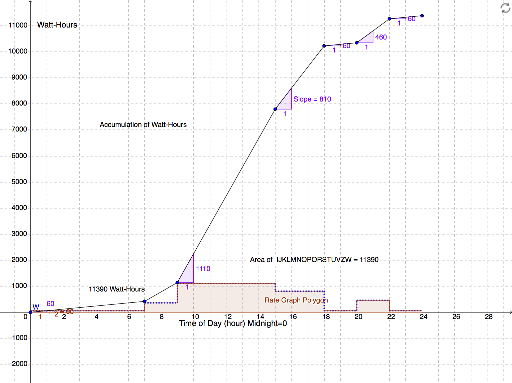
This example demonstrates how to use GeoGebra to construct and analyze geometric properties related to an electrical meter, focusing on quadratic functions, numerical calculations, optimization problems, and statistical analysis of areas. Key GeoGebra commands and objects used in the construction include Segment, Polygon, PointIn, and Slope, making it suitable for high school and above students to explore the integration of geometric constructions with optimization problems.
GeoGebra Commands & Parameters
Segment(A, B) → aSegment(C, D) → bSegment(E, F) → cSegment(G, H) → dSegment(I, J) → eSegment(J, K) → fSegment(K, L) → gSegment(L, M) → hSegment(M, N) → iSegment(N, O) → jSegment(O, P) → kSegment(P, Q) → lSegment(Q, R) → mSegment(R, S) → nSegment(S, T) → pSegment(T, U) → qSegment(U, V) → rPolygon(I, J, S, T, U, V, Z, W, K, L, M, N, O, P, Q, R) → poly1, i_1, r_1, s, t, u, v, z, w, j_1, k_1, l_1, m_1, n_1, o, p_1, q_1PointIn(poly1) → Pointpoly1Segment(W, A_1) → a_1Segment(B_1, A_1) → b_1Segment(B_1, C_1) → c_1Segment(C_1, D_1) → d_1Segment(D_1, E_1) → e_1Segment(E_1, F_1) → f_1Segment(F_1, G_1) → g_1Slope(c_1) → m_3Slope(a_1) → m_4Slope(d_1) → SlopeSlope(e_1) → m_6Slope(f_1) → m_7Slope(g_1) → m_8Slope(a_1) → m_2