
Basic Trapezoid Construction and Geometry
Loading the math board and drawing, please wait…
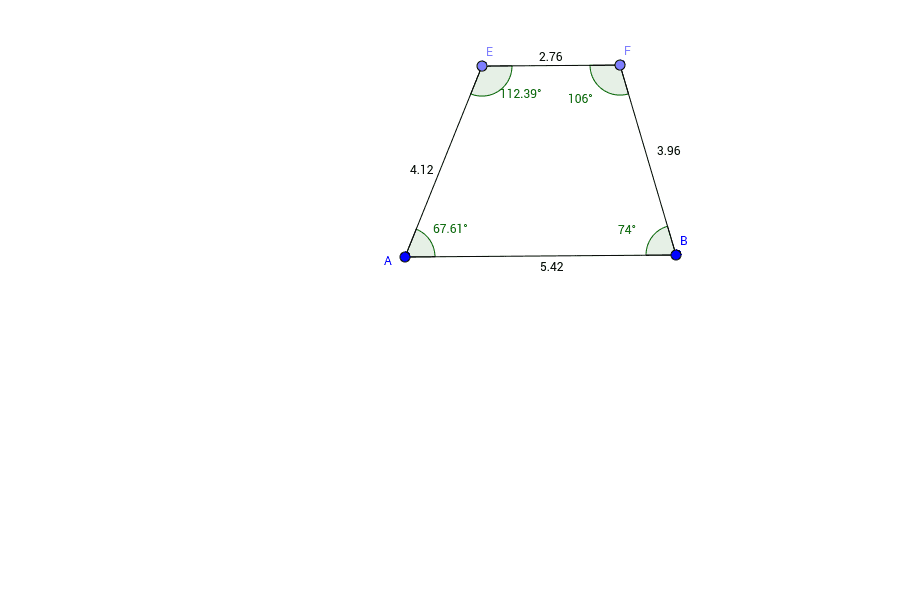
This GeoGebra example demonstrates the basic geometric construction of a trapezoid, illustrating key spatial relationships and angular properties. The core mathematical concepts include the definition of a trapezoid, parallel and orthogonal lines, vertex intersections, and the calculation of interior angles (α, β, γ, δ). To construct this figure, the tool utilizes commands such as Segment, OrthogonalLine, Point, Intersect, and Angle to define vertices A, B, C, D, E, F and the connecting segments, systematically calculating intersection points and visualizing the geometric constraints. It is highly suitable for secondary school geometry lessons, introductory construction tutorials, and interactive classroom demonstrations on polygon properties.
GeoGebra Commands & Parameters
Segment(A, B) → aOrthogonalLine(A, a) → bOrthogonalLine(B, a) → cPoint(b) → COrthogonalLine(C, b) → dIntersect(c, d) → DSegment(C, D) → ePoint(e) → EPoint(e) → FSegment(E, F) → fSegment(A, E) → gSegment(B, F) → hAngle(B, A, E) → αAngle(A, E, F) → βAngle(F, B, A) → γAngle(E, F, B) → δ