
Basic Terms in Geometry: Points, Lines, Rays, and Perpendiculars
Loading the math board and drawing, please wait…
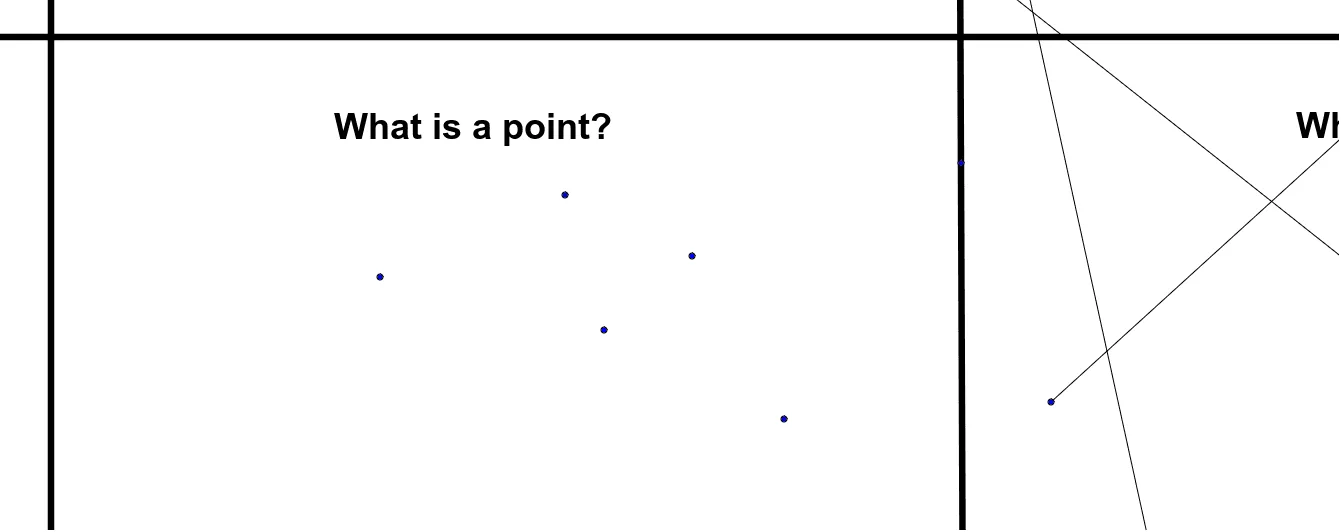
This GeoGebra example demonstrates fundamental geometric terms including points, lines, rays, and perpendicular lines through an interactive construction. It uses multiple labeled points (A through C₁) and line segments (a through j) to build a clear visual representation of how these basic elements relate to each other. The core mathematical concepts cover Euclidean geometry definitions, such as the nature of a point as a location, the infinite extension of a line, the one-directional property of a ray, and the right-angle relationship in perpendicular lines. The construction employs GeoGebra commands like Line for drawing infinite lines, Ray for creating rays, Point for marking key locations, and OrthogonalLine for constructing perpendiculars, with text objects adding labels. This resource is suitable for middle school or high school students beginning to learn geometric terminology, and also serves as a visual aid for teachers to explain abstract concepts in a concrete, interactive way.
GeoGebra Commands & Parameters
Line(F, G) → aRay(H, I) → bRay(J, K) → cRay(L, M) → dRay(N, O) → eRay(P, Q) → fLine(R, S) → gLine(T, U) → hLine(V, W) → iLine(Z, A_1) → jLine(B_1, C_1) → kLine(D_1, E_1) → lLine(F_1, G_1) → mLine(H_1, I_1) → nLine(I_1, n) → pLine(J_1, n) → qLine(K_1, q) → rLine(L_1, r) → sPoint(m) → M_1Line(M_1, m) → tLine(N_1, O_1) → a_1Line(P_1, Q_1) → b_1Line(R_1, S_1) → c_1Line(T_1, U_1) → d_1OrthogonalLine(V_1, b_1) → e_1OrthogonalLine(W_1, c_1) → f_1OrthogonalLine(Z_1, c_1) → g_1Line(A_2, B_2) → h_1Ray(C_2, D_2) → i_1Ray(E_2, F_2) → j_1Ray(G_2, H_2) → k_1Ray(I_2, J_2) → l_1Ray(K_2, L_2) → m_1Line(M_2, N_2) → n_1