
Base X Subtraction Machine
Loading the math board and drawing, please wait…
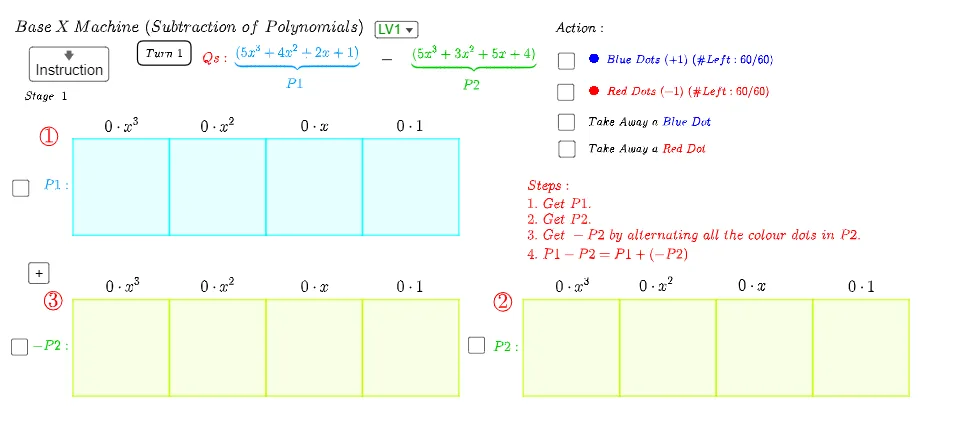
This example demonstrates the visual process of subtraction in any base, clearly showing the digit-by-digit subtraction and borrowing logic through bar charts. Core math concepts include base conversion, natural number operations, bar graph representation, functions, and geometric shapes like parabolas, ellipses, and pyramids. Construction highlights from the summary involve commands/objects such as Join, Polygon, IndexOf, First, If, Shuffle, Random, Textfield, and Point in GeoGebra for dynamic display. Suitable for middle school and above learners to understand different base operations and data visualization.
GeoGebra Commands & Parameters
Join({x31N, x32N}) → rx3NJoin({x31P, x32P}) → rx3PJoin({x11N, x12N}) → rx1NJoin({x11P, x12P}) → rx1PJoin({x21N, x22N}) → rx2NJoin({x21P, x22P}) → rx2PPolygon(I_3, J_3, K_3, L_3) → X31, a14, a16, a32, a29Polygon(L_3, M_3, N_3, K_3) → X21, a1, a27, a28, a3Polygon(M_3, P_3, O_3, N_3) → X11, a5, a25, a26, a7Polygon(P_3, Q_3, R_3, O_3) → X01, a9, a17, a24, a10Polygon(S_3, V_3, U_3, T_3) → X32, a23, a20, a21, a22Polygon(V_3, W_3, Z_3, U_3) → X22, a11, a19, a18, a12Polygon(W_3, B_4, A_4, Z_3) → X12, a13, a4, a2, a15Polygon(B_4, C_4, D_4, A_4) → X02, a31, a6, a8, a30Polygon(I_3, L_3, U_3, T_3) → Rx3, r11, r10, r9, r7Polygon(L_3, M_3, Z_3, U_3) → Rx2, r5, r4, r2, r3Polygon(M_3, P_3, A_4, Z_3) → Rx1, r6, r1, r14, r12Polygon(P_3, Q_3, D_4, A_4) → Rx0, r16, r15, r13, r8IndexOf(false, FP) → tmpIIndexOf(false, FN12) → NDtmpIFirst(x31P) → TAtmpIIf(NDtmpI ≟ NDtmpI, true, false) → NDHIf(Length[x31P] - Length[x31N] ≟ Element[Coef1, IndexOf["x^3", Order1]], true, false) → Bx31If(Length[x21P] - Length[x21N] ≟ Element[Coef1, IndexOf["x^2", Order1]], true, false) → Bx21If(Length[x11P] - Length[x11N] ≟ Element[Coef1, IndexOf["x", Order1]], true, false) → Bx11If(Length[x01P] - Length[x01N] ≟ Element[Coef1, IndexOf["", Order1]], true, false) → Bx01Shuffle({1, 2, 3, 4}) → OrderS, {3, 2, 1, 4}Random(-5, 5) → L23Co01Random(-5, 5) → L23Co02Random(-5, 5) → L23Co32Random(-5, 5) → L23Co31Random(-5, 5) → L23Co22Random(-5, 5) → L23Co21Random(-5, 5) → L23Co12Random(-5, 5) → L23Co11Join({x01N, x02N}) → rx0NJoin({x01P, x02P}) → rx0PIf(TAPP ≟ true ∧ TANN ≟ true, true, false) → TAPNFirst(rx0P) → tmpPFirst(rx0N) → tmpNIf(Element[tmpP, 1] ≟ Element[tmpP, 1], true, false) → tPIf(Element[tmpN, 1] ≟ Element[tmpN, 1], true, false) → tNTextfield(Br3) → Ir3Textfield(Br2) → Ir2Textfield(Br1) → Ir1Textfield(Br0) → Ir0Random(0, 5) → L1Co01Random(0, 5) → L1Co02Random(0, 5) → L1Co11Random(0, 5) → L1Co12Random(0, 5) → L1Co21Random(0, 5) → L1Co22Random(0, 5) → L1Co31Random(0, 5) → L1Co32Random(1, 2) → SignL1Polygon(A, B, C, D) → Background, a, b_1, c, dIndexOf(false, FP) → PDtmpIIf(PDtmpI ≟ PDtmpI, true, false) → PDHPolygon(E, F, K, J) → X33, b1, b3, b4, b2Polygon(F, G, L, K) → X23, b5, b6, b7, b8Polygon(G, H, M, L) → X13, b9, b10, b11, b12Polygon(H, I, N, M) → X03, b13, b16, b15, b14If(Length[x33P] - Length[x33N] ≟ Element[Coef2, IndexOf["x^3", Order2]], true, false) → Bx33If(Length[x23P] - Length[x23N] ≟ Element[Coef2, IndexOf["x^2", Order2]], true, false) → Bx23If(Length[x13P] - Length[x13N] ≟ Element[Coef2, IndexOf["x", Order2]], true, false) → Bx13If(Length[x03P] - Length[x03N] ≟ Element[Coef2, IndexOf["", Order2]], true, false) → Bx03If(Length[x32P] - Length[x32N] ≟ (-Element[Coef2, IndexOf["x^3", Order2]]), true, false) → Bx32If(Length[x22P] - Length[x22N] ≟ (-Element[Coef2, IndexOf["x^2", Order2]]), true, false) → Bx22If(Length[x12P] - Length[x12N] ≟ (-Element[Coef2, IndexOf["x", Order2]]), true, false) → Bx12If(Length[x02P] - Length[x02N] ≟ (-Element[Coef2, IndexOf["", Order2]]), true, false) → Bx02Point(xAxis) → RPolygon(O, P, Q, R) → PolyP2a, o, p, q, rIf(SelectedIndex[Level] ≟ 3 ∧ Stage ≟ 1, true, false) → BL3If(SelectedIndex[Level] ≟ 2 ∧ Stage ≟ 1, true, false) → BL2If(SelectedIndex[Level] ≟ 1 ∧ Stage ≟ 1, true, false) → BL1If(SelectedIndex[Level] ≟ 3, true, false) → BL3NIf(SelectedIndex[Level] ≟ 2, true, false) → BL2NIf(SelectedIndex[Level] ≟ 1, true, false) → BL1NIf(x11P ≠ {}, true, false) → TAPHIf(x11N ≠ {}, true, false) → TANH
AI Drawing Prompt Reference
Draw a base X subtraction machine that visually demonstrates the subtraction process of two numbers in any base. Use four bar charts to represent each digit of the two numbers, with the difference in bar length showing the subtraction result. Connect the endpoints of the bars with polygons to illustrate the borrowing process. Finally, use text boxes to display the calculation steps.
The prompt above was compiled from the original drawing commands and is for reference only.