
Balance (The Farmer's Stone)
Loading the math board and drawing, please wait…
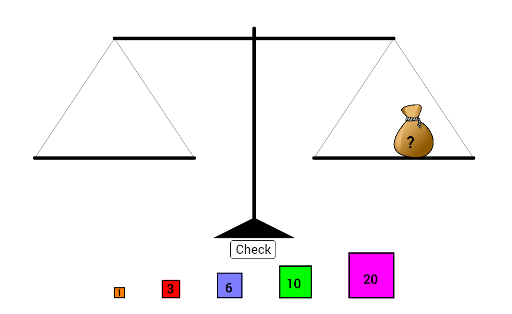
This example demonstrates a dynamic balance geometric model, showing the lever principle by adjusting weights and positions; core math concepts include equations, probability & statistics, area calculation, stochastic processes; constructed using GeoGebra commands like Join, RandomElement, Point, Polygon, Segment, If, Textfield, involving objects such as tipper, startingPoint, K_1anchor, weight; suitable for high school and above students to understand the integration of mechanics, probability, and geometric construction.
GeoGebra Commands & Parameters
Join({Sequence[Point[{i, 8}], i, -22, -10], Sequence[Point[{i, 8}], i, 6, 18]}) → startingPointRandomElement(startingPoint) → K_1anchorRandom(1, 40) → weightPoint({(-14 * cos((-tipper))), (14 * sin((-tipper))) + 20}) → leftPointPolygon(C_1 + (-2, 2), C_1 + (-2, -2), C_1 + (16, -2), C_1 + (16, 2)) → leftZone, t_1, a_1, b_1, c_1Polygon(A, B, 4) → poly1, f, g, h, i, K, LPolygon(C, D, 4) → poly2, j, k, l, m, M, NPolygon(E, F, 4) → poly3, n, p, q, r, O, PPolygon(G, H, 4) → poly4, s, t, a, b, Q, RPolygon(I, J, 4) → poly5, c, d, e, f_1, S, TPoint(xAxis) → UPoint(xAxis) → VPoint(yAxis) → WPolygon(U, V, W) → poly6, w, u, vSegment(W, Z) → g_1Point(g_1) → A_1Point({(14 * cos(tipper)), (14 * sin(tipper)) + 20}) → rightPointSegment(leftPoint, rightPoint) → h_1Segment(C_1, D_1) → i_1Segment(F_1, E_1) → j_1Segment(leftPoint, D_1) → k_1Segment(C_1, leftPoint) → l_1Segment(E_1, rightPoint) → n_1Segment(rightPoint, F_1) → m_1Polygon(F_1 + (-2, 2), F_1 + (-2, -2), F_1 + (16, -2), F_1 + (16, 2)) → rightZone, p_1, q_1, r_1, s_1If(abs(tipper) ≟ π / 6, true, false) → tippedTextfield(answerText) → InputBox1RandomElement({-1, 1}) → starterIf(Max[rightTotal, leftTotal] ≟ Min[rightTotal, leftTotal], 0, (1 / 3 * (Max[rightTotal, leftTotal] - Min[rightTotal, leftTotal])) + 4 / 3) → speed
AI Drawing Prompt Reference
Draw a dynamic balance geometric model demonstrating the lever principle, showing equilibrium by adjusting weights and positions. Include a tiltable lever with different weights at each end, calculated and probabilistic elements determining balance. Show the lever's starting point, pivot, weight positions, and areas formed by the lever and weights, with colors indicating weight differences, and label key points and areas.
The prompt above was compiled from the original drawing commands and is for reference only.