
Atomic Model Demonstration
Loading the math board and drawing, please wait…
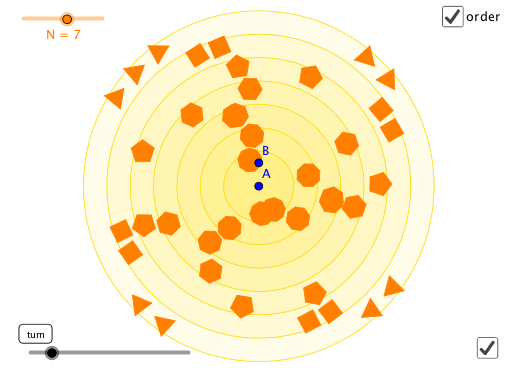
This example dynamically demonstrates atomic model structures through rotation and volume calculations. It involves core math concepts like rotation, volume, random variables, similar triangles, calculus, and ellipses. Construction highlights include using GeoGebra commands Segment, Point, Sequence, If to create objects N, A, d, f, B, dlt, and leveraging lists like list1, list2, list4, list5, and variables t, a, listspeed for animations. Suitable for high school and above students to explore spatial geometry and calculus applications.
GeoGebra Commands & Parameters
Segment((x(A), y(Corner[1])), (x(A), y(A) + d)) → fPoint(f) → BSequence(Polygon[Sequence[Rotate[B + (0, (j * d) + (0.9 * d / sqrt(3))), ((i * 360) * ° / (N + 2 - j)), B + (0, (j * d))], i, 1, N + 3 - j]], j, 0, N - 1) → list1Sequence(Sequence[Random[j, 6 + j] / 3, i, 1, j + 2], j, 1, N) → list2Sequence(Circle[A, B + ((i + 0.5) * (0, d))], i, 0, N - 1) → list4Sequence(Sequence[(i + j) / 3, i, 1, j + 2], j, 1, N) → list5If(a, list5, list2) → listspeedSequence(Sequence[Rotate[Rotate[Element[list1, j], ((t * 360))°, B + (0, ((j - 1) * d) + (dlt * d))], (((Element[Element[listspeed, j], i] * t) * 360))° + ((i / (j + 2) * 360))°, A], i, 1, j + 2], j, 1, N) → list3