
Assembling Pizzas
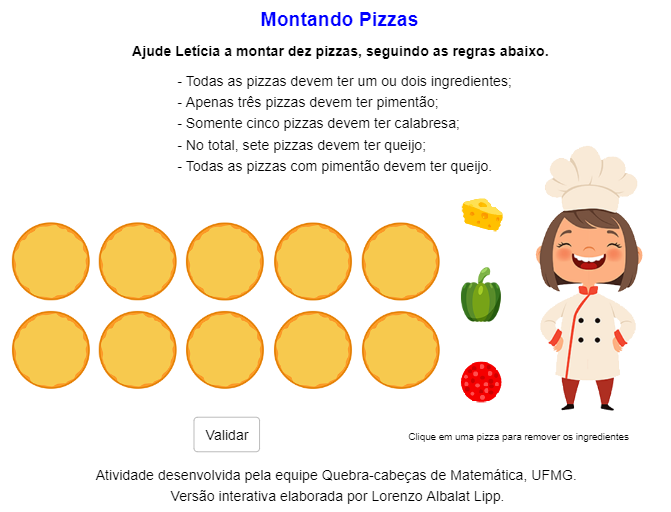
Loading the math board and drawing, please wait…
This example demonstrates how to assemble pizzas using geometric transformations. Key mathematical concepts include similar triangles, rotation, and homothety. Using GeoGebra commands such as objects, text, and rotation, the assembly process is dynamically illustrated. Suitable for middle school and above students to learn about geometric transformations and construction.
GeoGebra Commands & Parameters
Point A(7.928, -4.814)Point B(10.38, -4.83)Point C(6.288, -2.794)Point D(7.188, -2.794)Point E(6.308, -0.754)Point F(7.228, -0.754)Point G(6.288, -4.614)Point H(7.208, -4.614)Point I(-3.852, -2.31)Point J(-1.89, -2.31)Point K(0.078, -2.314)Point L(2.068, -2.314)Point M(4.048, -2.314)E + (0.5, 0.4)C + (0.45, 0.5)G + 0.45Numeric ok(NaN)
AI Drawing Prompt Reference
Draw an illustration of assembling three pizzas using geometric transformations to show their similarity and hierarchical relationships. First, create a horizontal sequence of cutting lines at the bottom of the画面, with five evenly spaced points arranged from left to right. Then, on the right side of the cutting lines, draw three vertically stacked pizza cross-sections, each represented as a rectangular slice side view. The bottom pizza is the largest, the middle one is slightly smaller, and the top one is the smallest, forming similar geometric shapes that demonstrate similarity and homothety. Each pizza consists of horizontal top and bottom edges with vertical sides, showing layers of crust, sauce, and toppings. The overall layout shows a progressive reduction from left to right, illustrating the scaling effect in geometric transformations.
The prompt above was compiled from the original drawing commands and is for reference only.