
Arsalan Box: Geometric Construction and Dynamic Folding of a Box
Loading the math board and drawing, please wait…
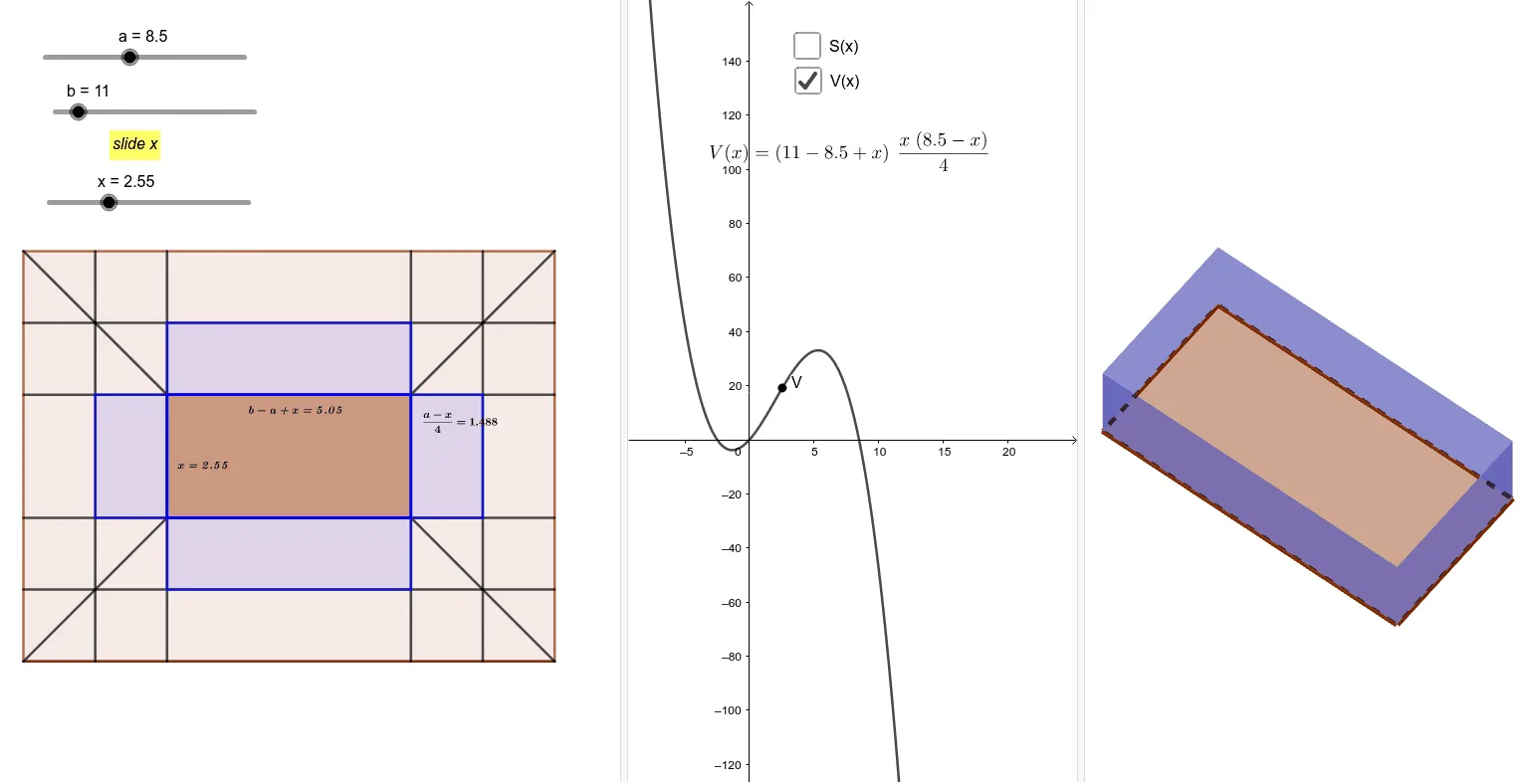
This GeoGebra example demonstrates how to construct a three-dimensional box by folding a flat net using geometric tools, visually illustrating the transition from 2D to 3D. The core mathematical concepts involve points, segments, polygons, perpendicular lines, circles, angle bisectors, midpoints, distance measurement, and transformations such as rotation. The construction uses commands like Point, Segment, OrthogonalLine, Circle, Intersect, Polygon, LineBisector, Distance, If, Rotate, Line, and Midpoint, with numerous auxiliary objects (a, b, A, B, f, g, c, C, h, i, D, q1, etc.) and a variable xvar controlling the fold anglecars. Distance variables (distanzaAE, distanzaDJ, distanzaJH) adjust the box dimensions dynamically. Suitable for high school or early college students learning geometric construction, transformations, and spatial reasoning, as well as for math labs or origami-based geometry explorations.
GeoGebra Commands & Parameters
Point(Circle[A, b]) → BSegment(A, B) → fOrthogonalLine(B, f) → gCircle(B, a) → cIntersect(c, g, 2) → COrthogonalLine(C, g) → hOrthogonalLine(A, f) → iIntersect(h, i) → DPolygon(A, B, C, D) → q1, a_1, b_1, c_1, dCircle(D, xvar) → eIntersect(f, a_1) → FCircle(A, xvar) → kIntersect(k, d, 1) → EOrthogonalLine(E, d) → jIntersect(j, b_1) → GSegment(E, G) → lLineBisector(D, E) → mIntersect(m, d) → HIntersect(m, b_1) → ISegment(H, I) → nCircle(D, xvar) → pIntersect(p, d, 1) → JOrthogonalLine(J, d) → qIntersect(q, b_1) → KSegment(J, K) → rLineBisector(J, A) → sIntersect(d, s) → LIntersect(s, b_1) → MSegment(L, M) → tDistance(A, E) → distanzaAEDistance(D, J) → distanzaDJDistance(J, H) → distanzaJHDistance(H, L) → distanzaHLDistance(L, E) → distanzaLECircle(C, b - a + xvar) → d_1Intersect(d_1, c_1, 1) → NOrthogonalLine(N, c_1) → f_1Intersect(f_1, f) → OSegment(N, O) → g_1LineBisector(D, N) → h_1Intersect(h_1, c_1) → PIntersect(h_1, f) → QSegment(P, Q) → i_1Circle(D, b - a + xvar) → e_1Intersect(e_1, c_1, 1) → ROrthogonalLine(R, c_1) → j_1Intersect(j_1, f) → S_2LineBisector(R, C) → k_1Intersect(k_1, c_1) → TIntersect(k_1, f) → USegment(T, U) → l_1Segment(R, S_2) → m_1Distance(D, P) → distanzaDPDistance(H, E) → distanzaHEDistance(J, L) → distanzaJLDistance(T, C) → distanzaTCDistance(D, R) → distanzaDRIntersect(n, i_1) → V_1Intersect(i_1, t) → WIntersect(t, l_1) → ZIntersect(l_1, n) → A_1LineBisector(T, C) → n_1LineBisector(D, P) → p_1LineBisector(D, H) → q_1LineBisector(L, A) → r_1If(xvar < a, Polygon[W, Z, A_1, V_1], q1) → q2Intersect(q_1, d) → B_1Intersect(q_1, b_1) → C_1Intersect(r_1, d) → D_1Intersect(b_1, r_1) → E_1Intersect(p_1, c_1) → F_1Intersect(p_1, f) → G_1Intersect(n_1, c_1) → H_1Intersect(n_1, f) → I_1Segment(B_1, C_1) → t_1Segment(D_1, E_1) → f_2Segment(F_1, G_1) → g_2Segment(H_1, I_1) → h_2Intersect(n, g_2) → J_1Intersect(t, g_2) → K_1Intersect(i_1, f_2) → L_1Intersect(l_1, f_2) → M_1Intersect(t, q1) → N_1, N_2Intersect(h_2, t) → O_1Intersect(n, h_2) → P_1Intersect(l_1, t_1) → Q_1Intersect(i_1, t_1) → R_1Polygon(L_1, M_1, Z, W) → q3, i_2, j_2, z_2, w_1Polygon(Z, O_1, P_1, A_1) → q4, z_3, o_1, k_2, l_2Polygon(A_1, Q_1, R_1, V_1) → q5, m_2, n_2, p_2, v_3Polygon(V_1, J_1, K_1, W) → q6, v_2, q_2, r_2, w_2Segment(A_1, C) → s_2Segment(Z, B) → t_2Segment(W, A) → a_2Segment(V_1, D) → b_2Distance(A_1, P_1) → distanzaA1P1Rotate(A_1, (-(90°)), m) → S_1Rotate(Q_1, (-(90°)), m) → T_1Rotate(R_1, (-(90°)), m) → U_1Rotate(V_1, (-(90°)), m) → W_1Polygon(S_1, T_1, U_1, W_1) → q5', c_2, d_2, u_1, e_2Rotate(L_1, 90°, s) → Z_1Rotate(M_1, 90°, s) → A_2Rotate(Z, 90°, s) → Z'Rotate(W, 90°, s) → W'Polygon(Z_1, A_2, Z', W') → q3', g_3, h_3, z', w'Line(P, Q) → i_3Line(T, U) → j_3Rotate(V_1, (-(90°)), i_3) → B_2Rotate(J_1, (-(90°)), i_3) → C_2Rotate(K_1, (-(90°)), i_3) → D_2Rotate(W, (-(90°)), i_3) → W'_1Polygon(B_2, C_2, D_2, W'_1) → q6', k_3, l_3, m_3, w'_1Rotate(Z, 90°, j_3) → Z'_1Rotate(O_1, 90°, j_3) → E_2Rotate(P_1, 90°, j_3) → F_2Rotate(A_1, 90°, j_3) → G_2Polygon(Z'_1, E_2, F_2, G_2) → q4', z'_1, n_3, p_3, q_3Midpoint(V_1, A_1) → H_2Midpoint(V_1, W) → I_2Midpoint(A_1, P_1) → J_2