
Arithmetic Sequence Sum by Idan Tal
Loading the math board and drawing, please wait…
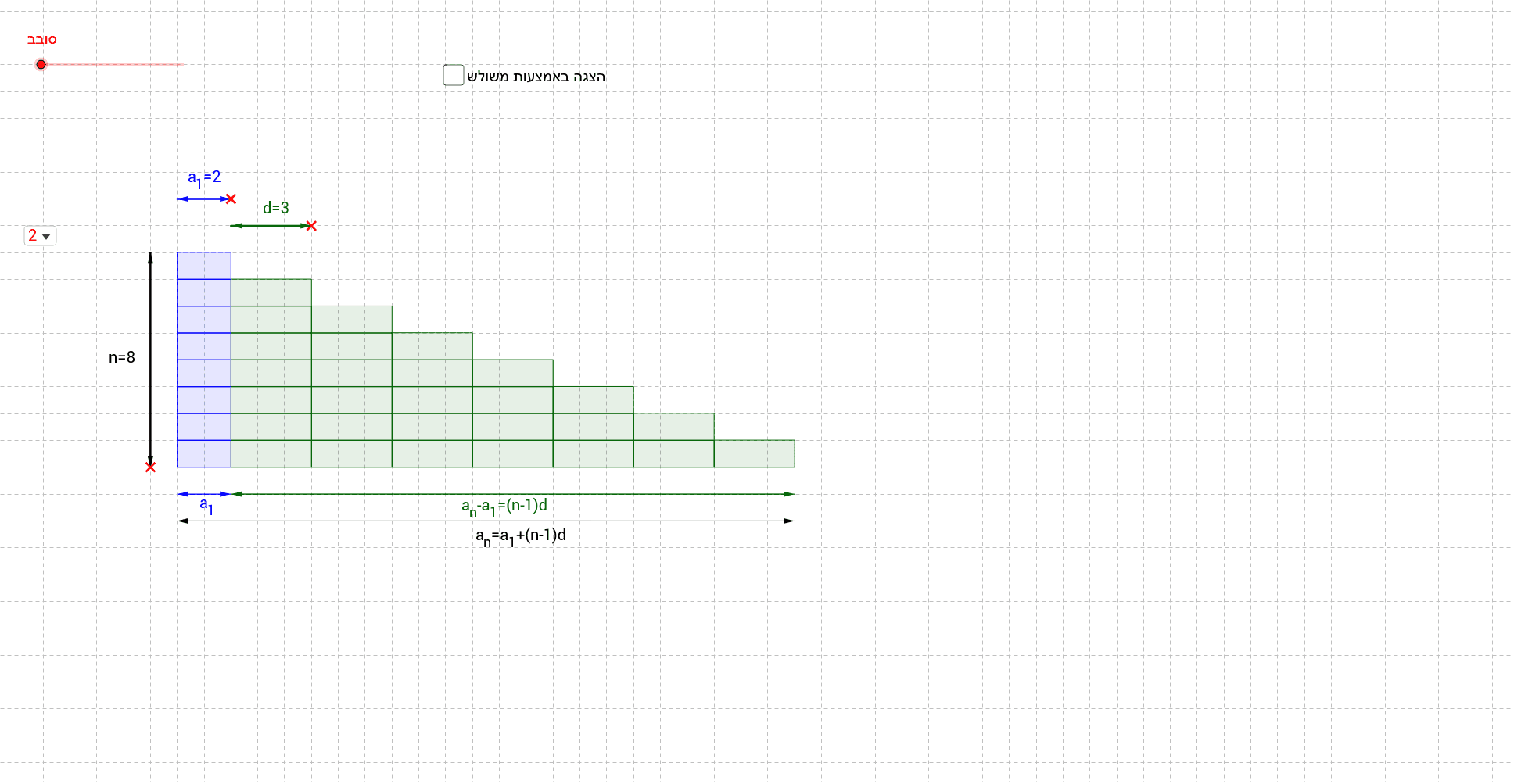
This example demonstrates the process of summing an arithmetic sequence. Key mathematical concepts include the definition and sum formula of an arithmetic sequence. Using GeoGebra commands such as Point, Segment, Polygon, Vector, Sequence, etc., it dynamically shows the generation and summation of an arithmetic sequence. Suitable for high school math education and learning.
GeoGebra Commands & Parameters
Point(Segment[(-1, -1), (-1, -10)]) → ASegment((-1, 0), A) → nPoint(Segment[(0, 2), (4, 2)]) → BPoint(Segment[(x(B), 1), (x(B) + 5, 1)]) → CSegment((x(B), 1), (x(C), 1)) → dSegment((0, 2), B) → a_1Polygon((0, 0), ((2 * a_1) + ((n - 1) * d), (-n)), (0, (-n))) → poly1, a, b, cVector((-1, 0), A) → kVector(A, (-1, 0)) → lSequence(Polygon[(0, (-k)), (0, (-k) - 1), (a_1, (-k) - 1), (a_1, (-k))], k, 0, n - 1) → list1Vector((0, 2), (x(B), 2)) → wVector((x(B), 2), (0, 2)) → jVector((x(B), 1), (x(C), 1)) → w_1Vector((x(C), 1), (x(B), 1)) → c_1Vector((a_1, (-n) - 1), (0, (-n) - 1)) → pVector((0, (-n) - 1), (a_1, (-n) - 1)) → mVector((a_1, (-n) - 1), (a_1 + ((n - 1) * d), (-n) - 1)) → qVector((a_1 + ((n - 1) * d), (-n) - 1), (a_1, (-n) - 1)) → rVector((a_1 + ((n - 1) * d), (-n) - 1), ((2 * a_1) + ((n - 1) * d), (-n) - 1)) → sVector(((2 * a_1) + ((n - 1) * d), (-n) - 1), (a_1 + ((n - 1) * d), (-n) - 1)) → tVector((0, (-n) - 2), (a_1 + ((n - 1) * d), (-n) - 2)) → uVector((a_1 + ((n - 1) * d), (-n) - 2), ((2 * a_1) + ((n - 1) * d), (-n) - 2)) → u_1Vector((a_1 + ((n - 1) * d), (-n) - 2), (0, (-n) - 2)) → vVector(((2 * a_1) + ((n - 1) * d), (-n) - 2), (a_1 + ((n - 1) * d), (-n) - 2)) → v_1Polygon((0, 0), Intersect[x = Length[a_1], a], (a_1, 0)) → poly2, e_1, f_1, g_1Rotate(poly2, (-α), (a_1 + ((0.5 * d) * (n - 1)), (-0.5 * n))) → poly2'Rotate(list1, (-α), (a_1 + ((0.5 * d) * (n - 1)), (-0.5 * n))) → list1'Zip(Sequence[Polygon[(a_1 + (d * (i - 1)), (-W)), (a_1 + (d * (i - 1)), (-W) - 1), (a_1 + (d * i), (-W) - 1), (a_1 + (d * i), (-W))], i, 1, W], W, Sequence[k, k, 0, Length[n] - 1]) → list2Rotate(list2, (-α), (a_1 + ((0.5 * d) * (n - 1)), (-0.5 * n))) → list2'Sequence(If[f(a_1 + ((k - 1) * d)) < (-k), Polygon[(a_1 + ((k - 1) * d), (-k)), (a_1 + (k * d), (-k)), (a_1 + (k * d), f(a_1 + (k * d))), (a_1 + ((k - 1) * d), f(a_1 + ((k - 1) * d)))], If[f(a_1 + (k * d)) < (-k), Polygon[Intersect[f, y = (-k)], (a_1 + (k * d), (-k)), (a_1 + (k * d), f(a_1 + (k * d)))]]], k, 1, n - 1) → list3Sequence(a_1 + ((i - 1) * d), i, 1, n) → list4Rotate(list3, (-α), (a_1 + ((0.5 * d) * (n - 1)), (-0.5 * n))) → list3'
AI Drawing Prompt Reference
Draw a geometric representation of an arithmetic sequence, including the first term a1, common difference d, and number of terms n. Start by drawing vectors for a1 and d, then generate the terms of the sequence using these vectors and represent each term with a polygon. Next, draw the polygon for the sum of the first n terms and the vectors for each term. Finally, rotate these elements to create a dynamic effect.
The prompt above was compiled from the original drawing commands and is for reference only.