
Area of a Parallelogram Exploration
Loading the math board and drawing, please wait…
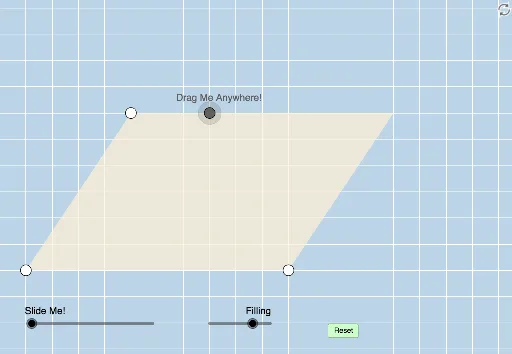
This dynamic illustration demonstrates that the area of a parallelogram is equal to the area of a rectangle with the same base and height. Key mathematical concepts include parallelograms, rectangles, and similarity transformations. Using GeoGebra commands such as Line, Segment, Polygon, and Dilate, the equivalence of areas can be visually understood. Suitable for middle school and above students to learn geometric transformations and area calculations.
GeoGebra Commands & Parameters
Line(A, B) → f_1Line(A, B) → bSlope(b) → mPointIn(d) → CSegment(A, B) → aLine(C, a) → fOrthogonalLine(B, f) → nIntersect(f, n) → HSegment(C, H) → lPoint(l) → IOrthogonalLine(I, l) → qIntersect(q, a) → JCircle(B, Distance[A, J]) → g_1Intersect(g_1, f_1, 2) → MSegment(A, C) → ePoint(f) → DRay(C, D) → gLine(B, e) → hIntersect(h, g) → ESegment(C, E) → iSegment(B, E) → jPoint(i) → FOrthogonalLine(A, i) → kAngle(B, A, C) → αRay(C, E) → pIntersect(f, k) → GSegment(G, E) → rPoint(r) → KOrthogonalLine(K, r) → sIntersect(s, a) → LPolygon(A, J, I, C) → poly1, a_1, j_1, i_1, c_1Polygon(J, B, E, I) → poly2, j_2, b_1, e_1, i_2Polygon(A, L, K, C) → poly3, a_2, l_1, k_1, c_2Polygon(L, B, E, K) → poly4, l_2, b_2, e_2, k_2Dilate(I, If[0 < o ≤ 1, 1 - o, 0], J) → I'Segment(I, I') → tAngle(J, I, E) → βDilate(J, If[2 < o ≤ 3, 3 - o, 0], M) → J'Vector(J, J') → uAngle(B, J, I) → γOrthogonalLine(E, b) → d_1Translate(A, u) → A'Translate(J, u) → J'_1Translate(I, u) → I'_1Translate(C, u) → C'Polygon(A', J'_1, I'_1, C') → poly1', a', j'_1, i'_1, c'Angle(I'_1, J', J) → δPolygon(A, B, E, C) → poly5, a_3, b_3, e_3, c_3Circle(E, Distance[C, K]) → h_1Intersect(h_1, f, 2) → NPolygon(A, B, E, C) → poly6, a_4, b_4, e_4, c_4Dilate(K, If[0 < o ≤ 1, 1 - o, 0], L) → K'Segment(K, K') → m_1Angle(L, K, E) → εAngle(B, L, K) → ζDilate(K, If[2 < o ≤ 3, 3 - o, 0], N) → K'_1Vector(K, K'_1) → vTranslate(A, v) → A'_1Translate(L, v) → L'Translate(K, v) → K'_2Translate(C, v) → C'_1Polygon(A'_1, L', K'_2, C'_1) → poly3', a'_1, l', k'_2, c'_1Angle(K'_1, L', A) → ηSegment(J'_1, I'_1) → n_1Segment(L', K'_2) → p_1