
Area of a Parallelogram and Rectangle Relationship
Loading the math board and drawing, please wait…
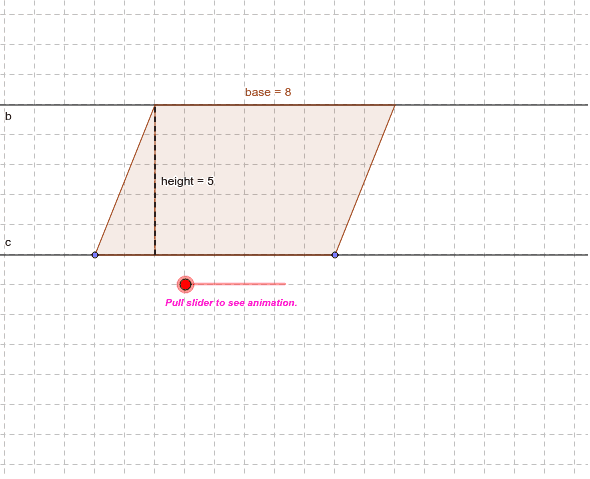
This GeoGebra example demonstrates how the area formula for a parallelogram is related to the area formula for a rectangle. It shows that a parallelogram can be transformed into a rectangle with the same base and height by cutting, translating, or rotating a triangular part, so the area remains base times height. The core concepts include parallelogram, rectangle, area, base, height, perpendicular distance, congruent pieces, equal-area transformation, vectors, translation, and rotation. The construction uses Point to define vertices A, B, C, and D; Line and Polygon to draw the parallelogram; OrthogonalLine and Intersect to create the height and foot of the perpendicular; Angle to mark angles; Distance to measure base and height; Vector and Translate to move a side or vertex and generate corresponding objects such as D', A', G', and P'; and If to control dynamic text and answer display such as T1, T2, and T3. It is suitable for upper primary or middle school geometry lessons, teacher demonstrations, and student exploration of area formulas in GeoGebra.
GeoGebra Commands & Parameters
Point(c) → BPoint(b) → DOrthogonalLine(D, c) → dIntersect(c, d) → GPoint(c) → APoint(c) → CAngle(B, A, D) → αRotate(C, α, B) → EAngle(C, B, E) → βLine(B, E) → aIntersect(b, a) → FPolygon(D, A, G) → P, g, d_1, a_1Polygon(G, B, F, D) → Q, g_1, b_1, base, d_2Distance(g_1, g) → hVector(((d_1 + g_1) * (1.0 - ttt), 0.0)) → uTranslate(D, u) → D'Translate(A, u) → A'Translate(G, u) → G'Polygon(D', A', G') → P', g', d', heightIf(e ≟ 100.0, AnchorPoint) → Showanswer