
Archimedes' Pi Approximation
Loading the math board and drawing, please wait…
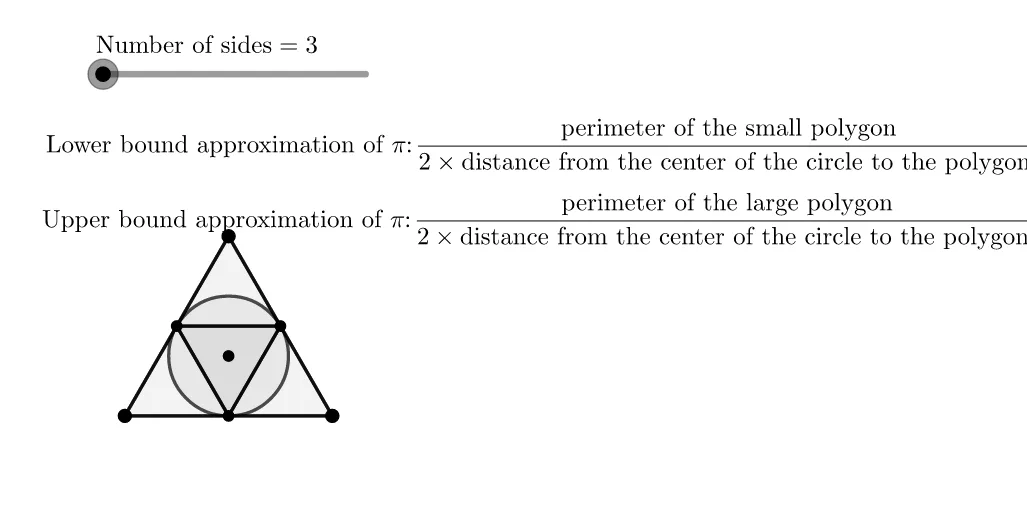
This example demonstrates how to approximate the value of Pi using Archimedes' method by inscribing and circumscribing polygons around a circle and calculating their perimeters; core mathematical concepts include circle, polygon, perimeter, limit, and geometric construction; construction highlights GeoGebra commands like Polygon, Centroid, Distance, Circle, If, Perimeter, and Circumference; suitable for high school and above students to understand the concept of limits and geometric approximation methods.
GeoGebra Commands & Parameters
Polygon(A, B, a) → poly1, f, m_1, t_{10}, C, E, F, G, I, P, R, T, V, p_1, Z, B_1, D_1, F_1, H_1, J_1, L_1, M_1, P_1, R_1, r_1, T_1, V_1, Z_1, B_2, D_2, F_2, H_2, J_2, L_2, N_2, t_1, P_2, Q_2, R_2, S_2, T_2, B_3, C_3, D_3, E_3, F_3, b_1, L_3, M_3, N_3, R_3, S_3, V_3, W_3, B_4, D_4, F_4, d_1, G_4, J_4, K_4, L_4, P_4, Q_4, T_4, U_4, Z_4, B_5, f_2, D_5, E_5, H_5, I_5, L_5, M_5, N_5, R_5, S_5, T_5, h_2, U_5, V_5, W_5, F_6, G_6, J_6, K_6, L_6, M_6, R_6, j_2, S_6, T_6, Z_6, A_7, B_7, C_7, D_7, E_7, L_7, M_7, k_2, N_7, R_7, S_7, T_7, U_7, B_8, C_8, D_8, E_8, g, n_2, q_2, s_2, a_2, c_2, e_2, g_3, i_3, k_3, m_3, h, p_3, r_3, t_3, a_3, b_3, c_3, d_3, j_4, k_4, l_4, i, m_4, n_4, a_4, b_4, c_4, g_5, h_5, k_5, l_5, p_5, j, r_5, t_5, a_5, d_5, e_5, f_6, j_6, k_6, n_6, p_6, t, s_6, a_6, c_6, d_6, g_7, h_7, k_7, l_7, m_7, r_7, g_1, s_7, t_7, a_7, b_7, c_7, j_8, k_8, n_8, p_8, q_8, i_1, r_8, c_8, d_8, e_8, i_9, j_9, k_9, l_9, m_9, n_9, k_1, b_9, c_9, d_9, h_{10}, i_{10}, j_{10}, k_{10}, q_{10}, r_{10}, s_{10}Centroid(poly1) → DDistance(D, Segment[B, C]) → bCircle(D, b) → cIf(a ≟ 3, Intersect[OrthogonalLine[A, Line[B, C]], Line[B, C]], Intersect[c, Line[A, C]]) → NIf(a ≟ 3, Intersect[OrthogonalLine[B, Line[A, C]], Line[A, C]], Intersect[c, Line[B, E]]) → MPerimeter(poly1) → kPolygon(N, M, a) → poly2, l, n_1, d_{10}, J, K, L, H, O, Q, S, U, W, q_1, A_1, C_1, E_1, G_1, I_1, K_1, N_1, O_1, Q_1, S_1, s_1, U_1, W_1, A_2, C_2, E_2, G_2, I_2, K_2, M_2, O_2, a_1, U_2, V_2, W_2, Z_2, A_3, G_3, H_3, I_3, J_3, K_3, c_1, O_3, P_3, Q_3, T_3, U_3, Z_3, A_4, C_4, E_4, H_4, e_1, I_4, M_4, N_4, O_4, R_4, S_4, V_4, W_4, A_5, C_5, g_2, F_5, G_5, J_5, K_5, O_5, P_5, Q_5, Z_5, A_6, B_6, i_2, C_6, D_6, E_6, H_6, I_6, N_6, O_6, P_6, Q_6, U_6, l_2, V_6, W_6, F_7, G_7, H_7, I_7, J_7, K_7, O_7, P_7, m_2, Q_7, V_7, W_7, Z_7, A_8, F_8, G_8, H_8, I_8, m, p_2, r_2, t_2, b_2, d_2, f_3, h_3, j_3, l_3, n_3, n, q_3, s_3, e_3, f_4, g_4, h_4, i_4, p_4, q_4, r_4, p, s_4, t_4, d_4, e_4, f_5, i_5, j_5, m_5, n_5, q_5, q, s_5, b_5, c_5, g_6, h_6, i_6, l_6, m_6, q_6, r_6, f_1, t_6, b_6, e_6, f_7, i_7, j_7, n_7, p_7, q_7, d_7, h_1, e_7, f_8, g_8, h_8, i_8, l_8, m_8, s_8, t_8, a_8, j_1, b_8, f_9, g_9, h_9, p_9, q_9, r_9, s_9, t_9, a_9, l_1, e_9, f_{10}, g_{10}, l_{10}, m_{10}, n_{10}, p_{10}, a_{10}, b_{10}, c_{10}Perimeter(poly2) → eCircumference(c) → r
AI Drawing Prompt Reference
Draw a circle and two polygons. First, construct a regular hexagon with the circle's center as one of its vertices and the circle's radius as the side length. Then, calculate the perimeter of this hexagon. Next, construct a circle with the hexagon's center as its center and the hexagon's side length as its radius. After that, construct a regular dodecagon inscribed in the circle with the circle's center as one of its vertices and the circle's radius as the side length. Finally, calculate the perimeter of this dodecagon.
The prompt above was compiled from the original drawing commands and is for reference only.