
Application of Vectors in Physics by Carlos Uribe Gartner
Loading the math board and drawing, please wait…
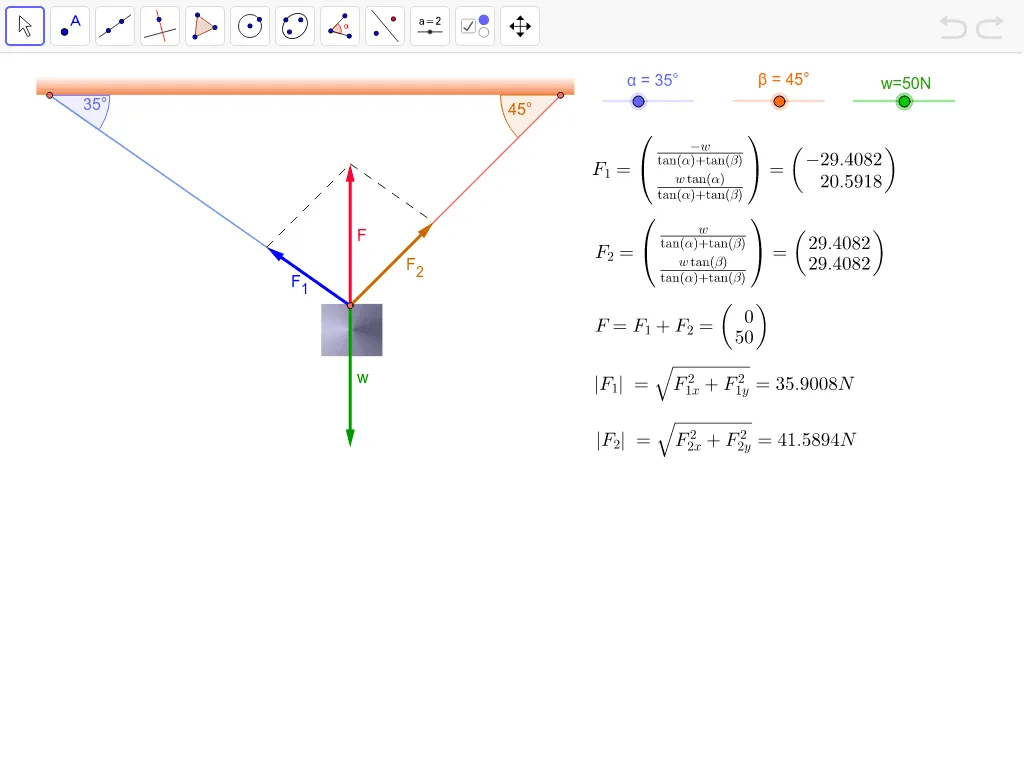
This example demonstrates the geometric representation and calculation of vectors in physics problems. Core math concepts include vectors, length, angles, rotation, intersection, line segments, and orthogonality. Construction highlights GeoGebra commands like Rotate, Line, Intersect, Segment, OrthogonalLine, Angle, Vector, and Length. Suitable for high school physics and mathematics education to understand vector operations and geometric applications.
GeoGebra Commands & Parameters
Rotate(A, β, B) → A'Rotate(B, -α, A) → B'Line(B, A') → aLine(A, B') → bIntersect(a, b) → CSegment(A, B) → cOrthogonalLine(C, c) → c'Intersect(Circle[C, e / 100], c', 2) → DIntersect(Circle[C, e / 100], c', 1) → EAngle(A, B, A') → δAngle(B', A, B) → γSegment(A, C) → dSegment(B, C) → fVector(C, D) → wVector(C, E) → FLine(E, f) → iLine(E, d) → jIntersect(i, d) → GIntersect(j, f) → HVector(C, G) → F_1Vector(C, H) → F_2Segment(G, E) → kSegment(E, H) → lLength(F1) → f1Length(F2) → f2
AI Drawing Prompt Reference
Draw a physics vector diagram: start with a horizontal base segment with endpoints. Rotate one endpoint around the other by an angle, and rotate the other endpoint around the first by an opposite angle; the two rotated rays intersect at a point, forming a triangle. From the intersection, drop a perpendicular to the base and mark two symmetric points on it. Label the two base angles. Connect the intersection to the two base endpoints to form two sides. From the intersection, draw vectors to the two symmetric points, then draw lines through each symmetric point parallel to the opposite side, intersecting the other side, creating two parallelograms. Finally, measure and label the lengths of these two vectors.
The prompt above was compiled from the original drawing commands and is for reference only.