
Application of Vectors in Physics by Alfredo
Loading the math board and drawing, please wait…
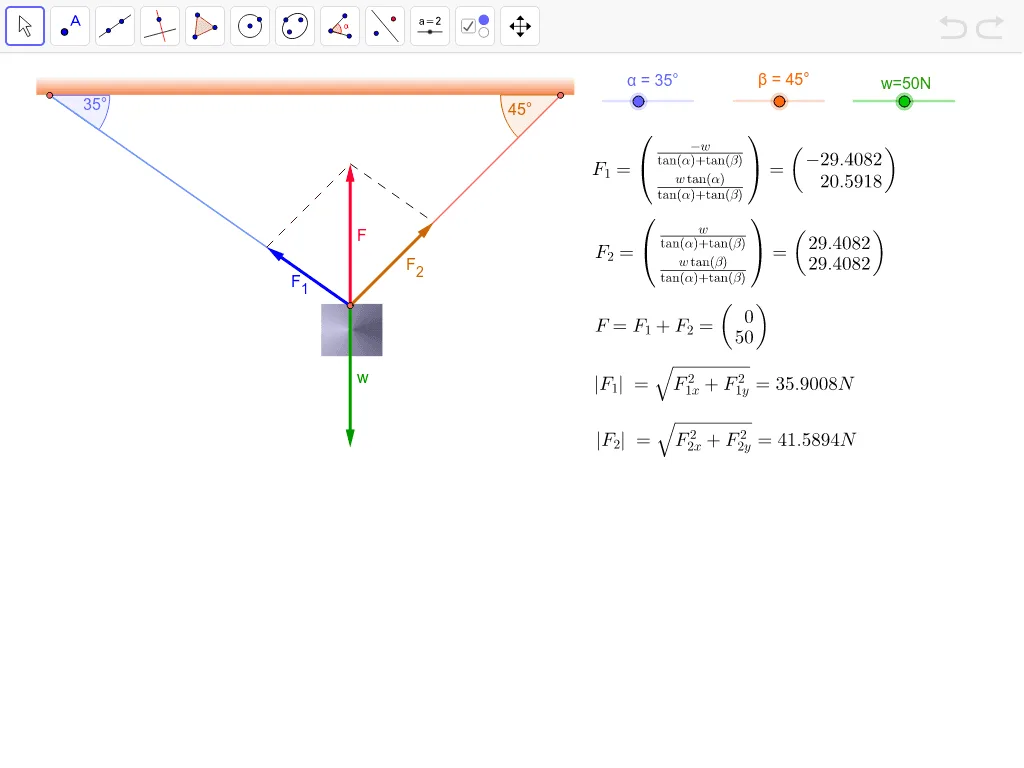
This example demonstrates the practical application of vectors in physics, visualizing vector addition and resolution through geometric constructions. Core math concepts include vector operations, trigonometry, and coordinate geometry. The construction leverages GeoGebra commands like Rotate, Line, Intersect, Segment, OrthogonalLine, Angle, Vector, and Length. Ideal for high school physics and mathematics education, aiding students in understanding the integration of vectors and geometry.
GeoGebra Commands & Parameters
Rotate(A, β, B) → A'Rotate(B, -α, A) → B'Line(B, A') → aLine(A, B') → bIntersect(a, b) → CSegment(A, B) → cOrthogonalLine(C, c) → c'Intersect(Circle[C, e / 100], c', 2) → DIntersect(Circle[C, e / 100], c', 1) → EAngle(A, B, A') → δAngle(B', A, B) → γSegment(A, C) → dSegment(B, C) → fVector(C, D) → wVector(C, E) → FLine(E, f) → iLine(E, d) → jIntersect(i, d) → GIntersect(j, f) → HVector(C, G) → F_1Vector(C, H) → F_2Segment(G, E) → kSegment(E, H) → lLength(F1) → f1Length(F2) → f2
AI Drawing Prompt Reference
Visualize vector addition and resolution in physics by constructing two vectors, rotating one to align with the other's tail, and forming a parallelogram. The intersection of the diagonals gives the resultant vector. Draw lines from the intersection to the tips of the original vectors and the ends of the diagonals. From the intersection, draw a perpendicular line intersecting a circle centered at the intersection to find points that form the components of the resultant vector. Label the key angles and lengths to illustrate the relationship between vector operations and geometry.
The prompt above was compiled from the original drawing commands and is for reference only.