
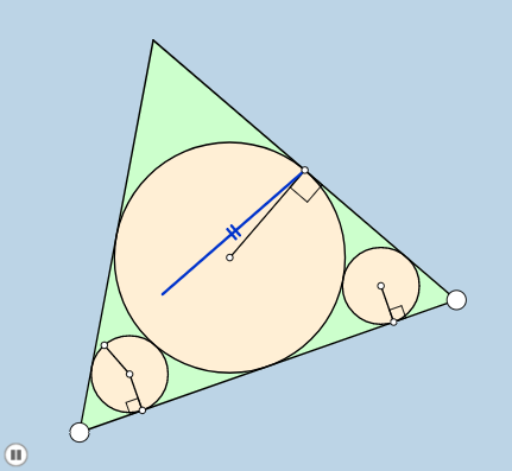
Animation 258: Incircle of an Equilateral Triangle
Loading the math board and drawing, please wait…
This example demonstrates the incircle of an equilateral triangle. The core mathematical concepts include triangles, incircles, and equilateral triangles. Using GeoGebra commands such as Polygon, Centroid, Tangent, and Dilate, the construction of an equilateral triangle and its incircle is illustrated. Suitable for middle and high school students to learn about geometric constructions and incircles.
GeoGebra Commands & Parameters
Polygon(A, B, 3) → poly1, f, g, h, CSegment(A, B) → iSegment(B, C) → jSegment(C, A) → kCentroid(poly1) → DOrthogonalLine(D, g) → lOrthogonalLine(D, i) → mIntersect(l, g) → ECircle(D, E) → cAngle(B, A, C) → αRotate(B, 30°, A) → B'Angle(B, A, B') → βLine(A, B') → nIntersect(c, n, 1) → FMidpoint(A, F) → GTangent(F, c) → p,Intersect(p, i) → HIntersect(p, h) → IPolygon(A, H, I) → poly2, i_1, a, h_1Centroid(poly2) → JCircle(J, F) → dIntersect(c, m, 2) → KTangent(K, c) → q,Intersect(q, g) → LIntersect(q, h) → MPolygon(M, L, C) → poly3, c_1, m_1, l_1Centroid(poly3) → NLine(B, D) → rIntersect(h, k) → OIntersect(r, h) → PIntersect(c, r) → Q, RTangent(Q, c) → s,Intersect(s, g) → SIntersect(s, i) → TPolygon(T, B, S) → poly4, s_1, t, bCentroid(poly4) → UCircle(U, Q) → d_1Dilate(A, If[0 < o ≤ 1, 1 - o, 0], B) → A'Segment(A, A') → a_1Rotate(A, If[1 < o ≤ 2, ((o - 1) * π / 3), π / 3], A) → A'_1Rotate(A', If[1 < o ≤ 2, ((o - 1) * π / 3), π / 3], A) → A''Segment(A'_1, A'') → b_1Rotate(A, If[2 < o ≤ 3, ((-(o - 2)) * π / 3), ((-π)) / 3], B) → A'_2Rotate(A', If[2 < o ≤ 3, ((-(o - 2)) * π / 3), ((-π)) / 3], B) → A''_1Segment(A'_2, A''_1) → e_1Intersect(d, dd, 1) → W_1Intersect(dd, a_1) → Z_1, A_1Intersect(ddd, a_1) → A_2, B_1Center(cc) → B_2OrthogonalLine(B_2, e_1) → k_3Intersect(k_3, e_1) → C_2Angle(B_2, C_2, B) → ιTangent(C_2, dd) → l_3, m_3Intersect(dd, l_3) → VCenter(dd) → C_1Center(ddd) → D_1Dilate(B_2, If[3.5 < o ≤ 4.5, 4.5 - o, 0], C_2) → E_1Dilate(C_1, If[3.5 < o ≤ 4.5, 4.5 - o, 0], A_1) → F_1Dilate(D_1, If[3.5 < o ≤ 4.5, 4.5 - o, 0], A_2) → G_1Segment(B_2, E_1) → f_1Segment(D_1, G_1) → g_1Segment(C_1, F_1) → j_1Angle(C_1, V, C_2) → δOrthogonalLine(C_1, a_1) → k_1Intersect(k_1, a_1) → H_1Angle(C_1, H_1, A) → γOrthogonalLine(D_1, a_1) → n_1Intersect(n_1, a_1) → I_1Angle(B, I_1, D_1) → εDilate(C_1, If[4.5 < o ≤ 5.5, 5.5 - o, 0], V) → K_1Segment(C_1, K_1) → p_1Dilate(C_2, If[5.5 < o ≤ 6.5, 6.5 - o, 0], V) → L_1Segment(C_2, L_1) → q_1Dilate(H_1, If[5.5 < o ≤ 6.5, 6.5 - o, 0], I_1) → M_1Dilate(V, If[6.5 < o ≤ 7.5, 7.5 - o, 0], C_1) → V'Vector(V, V') → uTranslate(C_2, u) → WTranslate(L_1, u) → ZSegment(W, Z) → eLine(A, B) → r_1Line(V, r_1) → t_1Point(t_1) → N_1Angle(N_1, V, C_2) → ζRotate(W, If[7.5 < o ≤ 8.5, ((-(o - 7.5)) * ζ), (-ζ)], C_1) → W'Rotate(Z, If[7.5 < o ≤ 8.5, ((-(o - 7.5)) * ζ), (-ζ)], C_1) → Z'Segment(W', Z') → e'