
Animated Demonstration of Pythagoras Theorem
Loading the math board and drawing, please wait…
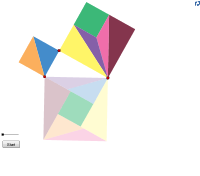
This example animates the Pythagorean Theorem, which states that in a right-angled triangle, the square of the hypotenuse is equal to the sum of the squares of the other two sides. Key mathematical concepts include right triangles and the Pythagorean theorem. The construction uses commands such as semicircle, intersect, circle arc, point, segment, mirror, polygon, orthogonal line, rotate, midpoint, and if statement. Suitable for middle school and above students and teachers.
GeoGebra Commands & Parameters
Semicircle(A4, A5) → cIntersect(c, LineBisector[A4, A5]) → A,CircleArc(Midpoint[A4, A5], A, A4) → r_1Point(r_1) → A6Segment(A6, A5) → bMirror(A4, b) → A12Polygon(A6, A5, 4) → poly2, c_2, b_1, g, h, A9, A10OrthogonalLine(A12, h) → mSegment(A10, A5) → jIntersect(m, j) → A11Rotate(A6, 90*°, A5) → B8Segment(A4, A6) → aSegment(A5, A4) → dPolygon(A4, A6, 4) → poly1, a_1, c_1, e, f, A7, A8Segment(A4, A7) → iMirror(A12, j) → A13Segment(A5, A12) → k_1Segment(A5, A13) → lSegment(A11, A13) → nSegment(A11, A12) → pPolygon(A5, A4, 4) → poly4, b_2, a_2, k, q, B12, B6Rotate(A11, 90*°, A5) → B7Midpoint(A4, B6) → ORotate(B8, 90*°, O) → B10Rotate(B10, 90*°, O) → B11Rotate(B11, 90*°, O) → B13Rotate(B7, 180*°, O) → B9Segment(B13, B8) → rSegment(B8, B10) → sSegment(B11, B13) → d_1Segment(B11, A4) → e_1Segment(B13, B12) → f_1Segment(B8, B6) → g_1Segment(B10, A5) → h_1Segment(B7, A5) → j_1Segment(B9, B12) → p_1Segment(B10, B11) → q_1Polygon(C4, C5, C6, C7) → poly3, c2, c3, c4, c5Polygon(D4, D5, D6) → poly5, d4, d2, d3Polygon(E4, E5, E6) → poly6, e4, e2, e3Polygon(F4, F5, F6) → poly7, f4, f2, f3Polygon(G4, G5, G6) → poly8, g4, g2, g3Polygon(H4, H5, H6) → poly9, h4, h2, h3Polygon(I4, I5, I6) → poly10, i4, i2, i3If(time < C$2, C4, If[(C$2 ≤ time) ∧ (time < C$3), C4 - (time - C$2) * (C4 - C9) / (C$3 - C$2), C9]) → J4If(time < C$2, C5, If[(C$2 ≤ time) ∧ (time < C$3), C5 - (time - C$2) * (C5 - C10) / (C$3 - C$2), C10]) → J5If(time < C$2, C6, If[(C$2 ≤ time) ∧ (time < C$3), C6 - (time - C$2) * (C6 - C11) / (C$3 - C$2), C11]) → J6If(time < C$2, C7, If[(C$2 ≤ time) ∧ (time < C$3), C7 - (time - C$2) * (C7 - C12) / (C$3 - C$2), C12]) → J7If(time < D$2, D4, If[(D$2 ≤ time) ∧ (time < D$3), D4 - (time - D$2) * (D4 - D9) / (D$3 - D$2), D9]) → K4If(time < D$2, D5, If[(D$2 ≤ time) ∧ (time < D$3), D5 - (time - D$2) * (D5 - D10) / (D$3 - D$2), D10]) → K5If(time < D$2, D6, If[(D$2 ≤ time) ∧ (time < D$3), D6 - (time - D$2) * (D6 - D11) / (D$3 - D$2), D11]) → K6If(time < E$2, E4, If[(E$2 ≤ time) ∧ (time < E$3), E4 - (time - E$2) * (E4 - E9) / (E$3 - E$2), E9]) → L4If(time < E$2, E5, If[(E$2 ≤ time) ∧ (time < E$3), E5 - (time - E$2) * (E5 - E10) / (E$3 - E$2), E10]) → L5If(time < E$2, E6, If[(E$2 ≤ time) ∧ (time < E$3), E6 - (time - E$2) * (E6 - E11) / (E$3 - E$2), E11]) → L6If(time < F$2, F4, If[(F$2 ≤ time) ∧ (time < F$3), F4 - (time - F$2) * (F4 - F9) / (F$3 - F$2), F9]) → M4If(time < F$2, F5, If[(F$2 ≤ time) ∧ (time < F$3), F5 - (time - F$2) * (F5 - F10) / (F$3 - F$2), F10]) → M5If(time < F$2, F6, If[(F$2 ≤ time) ∧ (time < F$3), F6 - (time - F$2) * (F6 - F11) / (F$3 - F$2), F11]) → M6If(time < G$2, G4, If[(G$2 ≤ time) ∧ (time < G$3), G4 - (time - G$2) * (G4 - G9) / (G$3 - G$2), G9]) → N4If(time < G$2, G5, If[(G$2 ≤ time) ∧ (time < G$3), G5 - (time - G$2) * (G5 - G10) / (G$3 - G$2), G10]) → N5If(time < G$2, G6, If[(G$2 ≤ time) ∧ (time < G$3), G6 - (time - G$2) * (G6 - G11) / (G$3 - G$2), G11]) → N6If(time < H$2, H4, If[(H$2 ≤ time) ∧ (time < H$3), H4 - (time - H$2) * (H4 - H9) / (H$3 - H$2), H9]) → O4If(time < H$2, H5, If[(H$2 ≤ time) ∧ (time < H$3), H5 - (time - H$2) * (H5 - H10) / (H$3 - H$2), H10]) → O5If(time < H$2, H6, If[(H$2 ≤ time) ∧ (time < H$3), H6 - (time - H$2) * (H6 - H11) / (H$3 - H$2), H11]) → O6If(time < I$2, I4, If[(I$2 ≤ time) ∧ (time < I$3), I4 - (time - I$2) * (I4 - I9) / (I$3 - I$2), I9]) → P4If(time < I$2, I5, If[(I$2 ≤ time) ∧ (time < I$3), I5 - (time - I$2) * (I5 - I10) / (I$3 - I$2), I10]) → P5If(time < I$2, I6, If[(I$2 ≤ time) ∧ (time < I$3), I6 - (time - I$2) * (I6 - I11) / (I$3 - I$2), I11]) → P6Polygon(J4, J5, J6, J7) → poly11, j4, j5, j6, j7Polygon(K4, K5, K6) → poly12, k6, k4, k5Polygon(L4, L5, L6) → poly13, l6, l4, l5Polygon(M4, M5, M6) → poly14, m6, m4, m5Polygon(N4, N5, N6) → poly15, n6, n4, n5Polygon(O4, O5, O6) → poly16, o6, o4, o5Polygon(P4, P5, P6) → poly17, p6, p4, p5Polygon(C9, C10, C11, C12) → poly18, c9, c10, c11, c12Polygon(D9, D10, D11) → poly19, d11, d9, d10Polygon(E9, E10, E11) → poly20, e11, e9, e10Polygon(F9, F10, F11) → poly21, f11, f9, f10Polygon(G9, G10, G11) → poly22, g11, g9, g10Polygon(H9, H10, H11) → poly23, h11, h9, h10Polygon(I9, I10, I11) → poly24, i11, i9, i10
AI Drawing Prompt Reference
Draw a right triangle ABC with AB as the hypotenuse. Use rotation and mirroring to construct three smaller similar triangles, each with an area equal to the square of one of the legs of the original triangle. Adjust the size of the triangle using a slider to observe changes in the area relationships.
The prompt above was compiled from the original drawing commands and is for reference only.