
Angles on Parallel Lines by azb
Loading the math board and drawing, please wait…
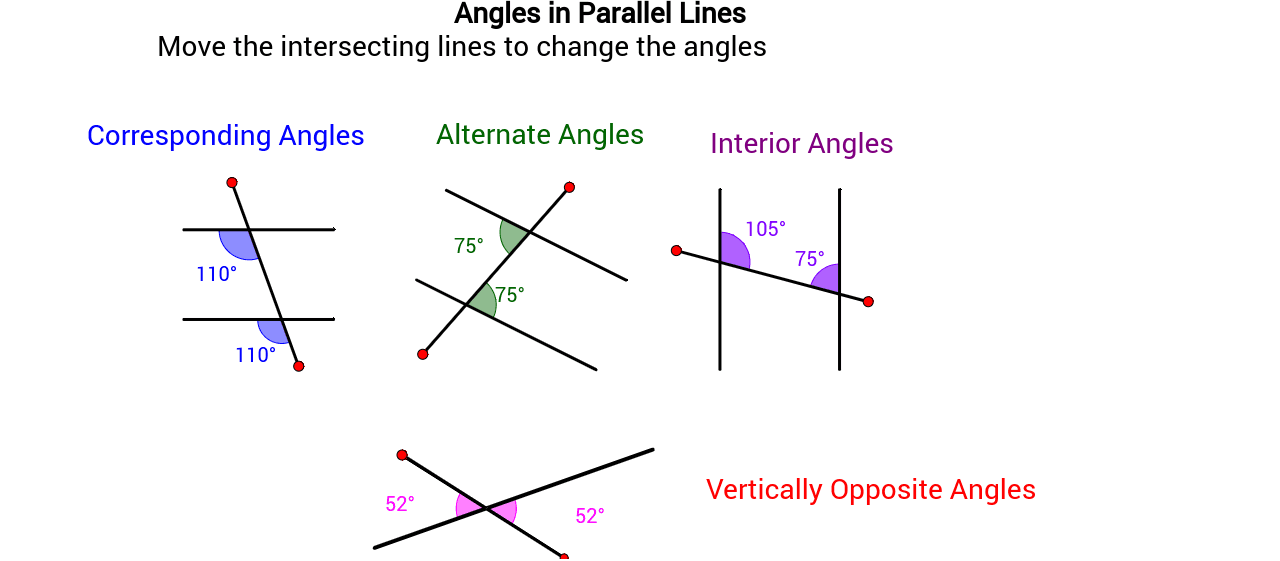
This example demonstrates the relationships between alternate interior angles, corresponding angles, and consecutive interior angles formed by parallel lines. Key math concepts include properties of parallel lines, angle equality, and angle supplementation. Construction involves using Segment, Intersect, Angle, and Point commands in GeoGebra to draw lines, find intersections, measure angles, and mark points. Suitable for middle school and high school students learning parallel line geometry and geometric proofs.
GeoGebra Commands & Parameters
Segment(A, B) → aSegment(C, D) → bSegment(E, F) → cIntersect(b, c) → GIntersect(a, c) → HAngle(b, c) → αSegment(I_1, J_1) → d_1Segment(K_1, L_1) → e_1Segment(M_1, N_1) → f_1Intersect(d_1, f_1) → O_1Intersect(e_1, f_1) → P_1Point(b) → UIntersect(b, c) → VPoint(a) → WPoint(a) → A_1Point(b) → B_1Point(d_1) → C_1Point(d_1) → D_1Point(d_1) → E_1Point(e_1) → F_1Intersect(e_1, f_1) → G_1Point(e_1) → H_1Intersect(a, c) → ZAngle(A_1, Z, F) → βIntersect(d_1, f_1) → W_1Point(d_1) → Z_1Point(d_1) → A_2Point(e_1) → B_2Intersect(e_1, f_1) → C_2Point(e_1) → D_2Intersect(b, c) → E_2Intersect(a, c) → F_2Intersect(e_1, f_1) → G_2Point(b) → K_2Point(a) → L_2Point(b) → M_2Point(a) → N_2Point(d_1) → O_2Point(e_1) → P_2Point(e_1) → Q_2Point(d_1) → R_2Intersect(d_1, f_1) → H_2Angle(O_2, H_2, G_2) → γAngle(Q_2, G_2, H_2) → δSegment(M_3, N_3) → d_2Segment(O_3, P_3) → e_2Segment(Q_1, R_1) → f_2Intersect(d_2, f_2) → S_2Intersect(e_2, f_2) → T_1Intersect(d_2, f_2) → Q_3Point(d_2) → R_3Intersect(e_2, f_2) → S_3Point(e_2) → T_2Point(e_2) → U_1Point(d_2) → V_2Intersect(d_2, f_2) → I_2Intersect(e_2, f_2) → J_2Point(d_2) → S_1Point(d_2) → T_3Point(e_2) → U_2Point(e_2) → V_1Angle(J_2, I_2, S_1) → η_1Angle(V_1, J_2, I_2) → ε_1Segment(Q, R) → dSegment(S, T) → eAngle(e, d) → εIntersect(d, e) → W_2Segment(W_2, Q) → fAngle(S, W_2, Q) → ζ
AI Drawing Prompt Reference
Draw two parallel lines a and b, and two intersecting lines c and d. Mark their intersections as G, H, O, P, Z, W, V, and U. Measure angles α, β, γ, and δ, which are the angles formed by c and d, a and c, d1 and f1, and e1 and f1, respectively.
The prompt above was compiled from the original drawing commands and is for reference only.