
Angles in a Hexagon: Exploring Interior Angles and Prism Connections
Loading the math board and drawing, please wait…
In collections
Angles of Polygons
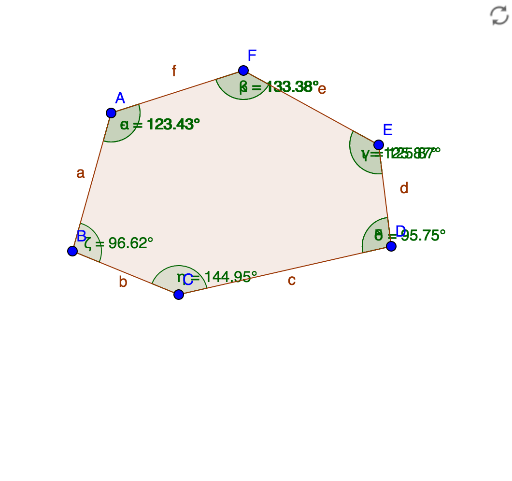
① This GeoGebra example dynamically displays the interior angles of a hexagon (ABCDEF) and relates them to angles in a prism, illustrating the connection between polygon angles and solid geometry concepts like dihedral angles or lateral face angles. ② Core mathematical concepts include the polygon interior angle sum theorem (hexagon sum = 720°), angle measurement, and the geometric relationship between polygons and prisms, with extensions to sine and combinatorics. ③ Construction highlights: the Polygon command creates hexagon poly1 with vertices A, B, C, D, E, F; the Angle command marks interior angles α, β, γ, δ, ε, ζ, plus additional angles η, θ, ι, κ possibly for diagonals or exterior angles; objects include sides a, b, c, d, e, f for dynamic adjustment. ④ Suitable for middle school to high school students learning polygon properties, angle concepts, and introductory solid geometry, as well as for teacher demonstrations or student self-exploration of angle relationships in prisms.
GeoGebra Commands & Parameters
Polygon(A, B, C, D, E, F) → poly1, a, b, c, d, e, fAngle(B, A, F) → αAngle(A, F, E) → βAngle(F, E, D) → γAngle(E, D, C) → δAngle(poly1) → ε, ζ, η, θ, ι, κ
AI Drawing Prompt Reference
Draw a regular hexagon with vertices labeled in clockwise order, showing all interior angles marked with arcs. Include diagonals inside the hexagon to create additional angles. The figure should clearly illustrate that the sum of interior angles is 720 degrees, and hint at connections to prism lateral face angles or dihedral angles. Make the side lengths or vertex positions adjustable for dynamic exploration.
The prompt above was compiled from the original drawing commands and is for reference only.