
Angles at a Point Sum to 360°
Loading the math board and drawing, please wait…
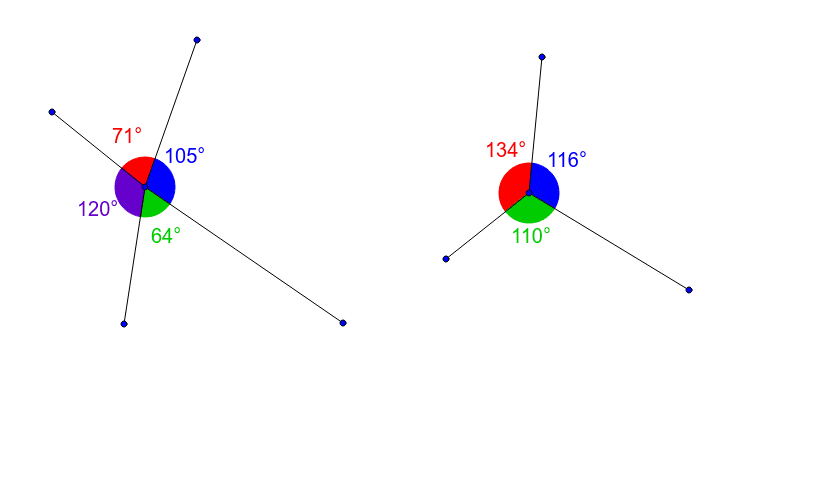
This interactive example demonstrates the theorem 'Angles at a point sum to 360°'. It involves core math concepts like angles, polygon interior angles, and geometric construction. The construction uses commands like Segment and Angle, along with objects such as points (A, B, C, D, E) and angles (a, b, c, d, α, β, γ, δ). Suitable for middle school students and above to learn polygon angle sums and geometric constructions.
GeoGebra Commands & Parameters
Segment(B, A) → aSegment(C, A) → bSegment(D, A) → cSegment(E, A) → dAngle(B, A, E) → αAngle(C, A, B) → βAngle(D, A, C) → γAngle(E, A, D) → δSegment(B_1, A_1) → a_1Segment(C_1, A_1) → b_1Segment(E_1, A_1) → d_1Angle(B_1, A_1, E_1) → α_1Angle(C_1, A_1, B_1) → β_1Angle(E_1, A_1, C_1) → ε
AI Drawing Prompt Reference
Draw a point and five line segments radiating from it to different points, forming five angles. Measure and label the size of each angle. Then draw two more line segments from the point to create three additional angles, measure and label them. Finally, arrange all eight angles around the point to demonstrate that their sum equals 360 degrees.
The prompt above was compiled from the original drawing commands and is for reference only.