
Angles associated with parallel lines
Loading the math board and drawing, please wait…
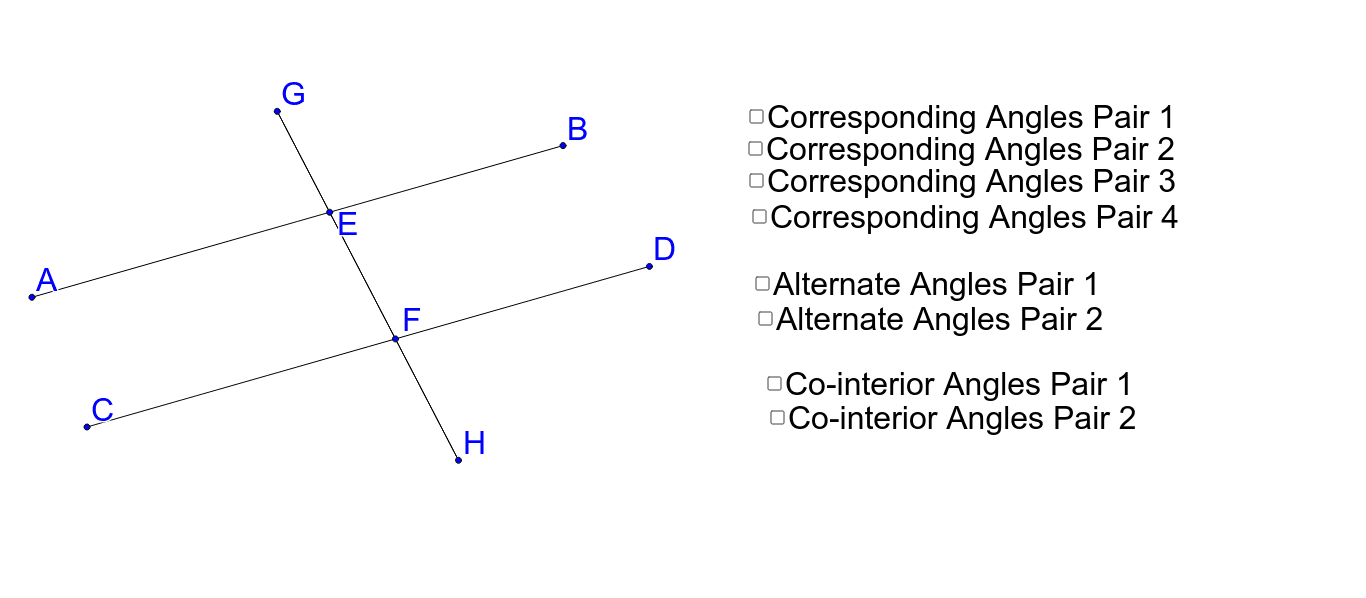
This example demonstrates the geometric relationship between parallel lines and their associated angles. Key mathematical concepts include properties of parallel lines, angle measurement, and geometric construction. Construction involves using GeoGebra commands such as Segment, Line, Point, and Angle. Suitable for middle or high school mathematics education to understand geometric foundations and angle calculations.
GeoGebra Commands & Parameters
Segment(A, B) → aLine(C, a) → bPoint(b) → DSegment(C, D) → cPoint(a) → EPoint(c) → FLine(F, E) → dPoint(d) → GPoint(d) → HSegment(G, H) → eAngle(F, E, B) → αAngle(E, F, C) → βAngle(A, E, F) → γAngle(D, F, E) → δAngle(B, E, G) → εAngle(D, F, E) → ζAngle(G, E, A) → ηAngle(E, F, C) → θAngle(A, E, F) → ιAngle(C, F, H) → κAngle(F, E, B) → λAngle(H, F, D) → μSegment(H, G) → nAngle(B, E, F) → νAngle(E, F, D) → ξAngle(A, E, F) → οAngle(E, F, C) → ρ
AI Drawing Prompt Reference
Draw two parallel lines with a transversal line crossing them, creating multiple intersection points. Mark the angles formed where the transversal intersects the first parallel line and the second parallel line. Show the relationships between corresponding angles, alternate interior angles, and vertical angles, with angle labels including α, β, γ, δ, ε, η, θ, κ, λ, μ, ν, and ξ.
The prompt above was compiled from the original drawing commands and is for reference only.