
Angles and Parallel Lines Discovery
Loading the math board and drawing, please wait…
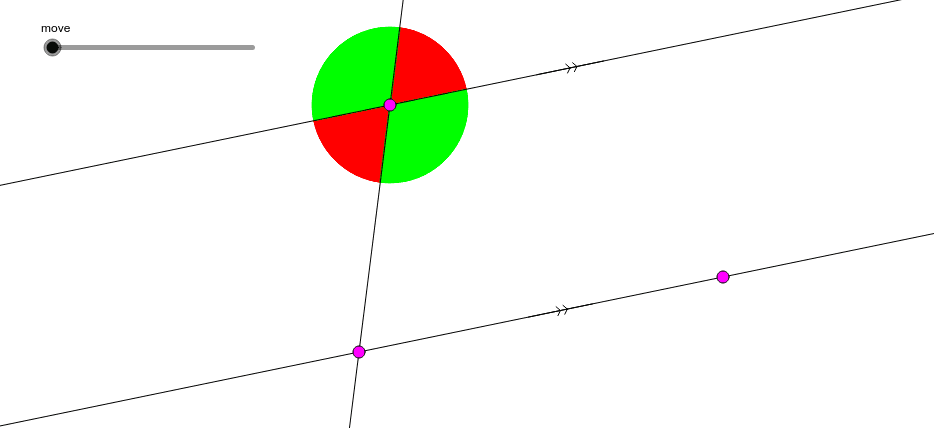
This example demonstrates the angle relationships formed when parallel lines are cut by a transversal. It involves core math concepts like alternate interior angles, corresponding angles, and consecutive interior angles, highlighting their properties of being congruent or supplementary. Constructed using GeoGebra commands such as Line, Circle, Intersect, CircleSector, Dilate, Vector, Translate, Point, and Segment, it is suitable for middle school and above students to visually understand parallel line theorems and develop geometric proof and spatial reasoning skills.
GeoGebra Commands & Parameters
Line(A, B) → aLine(A, C) → bLine(C, a) → cCircle(C, 2) → dCircle(A, 2) → eIntersect(d, c) → D, EIntersect(d, b) → F, GCircleSector(C, E, G) → fCircleSector(C, G, D) → gCircleSector(C, D, F) → hCircleSector(C, F, E) → kDilate(A, move, C) → A'Vector(C, A') → uTranslate(h, u) → h'Translate(f, u) → f'Translate(d, u) → d'Translate(g, u) → g'Translate(k, u) → k'Point(c) → HPoint(c) → ISegment(H, I) → iPoint(a) → JPoint(a) → KSegment(J, K) → j
AI Drawing Prompt Reference
Draw two parallel lines intersected by a transversal, forming eight angles. Use circles and sectors to highlight alternate interior angles, corresponding angles, and consecutive interior angles, which are congruent or supplementary. Translate one of the angle sectors along the direction of the parallel lines, showing the original and translated sectors along with connecting segments between corresponding points to illustrate the properties of parallel lines.
The prompt above was compiled from the original drawing commands and is for reference only.