
Angles and Dilations
Loading the math board and drawing, please wait…
In collections
Investigating Dilation
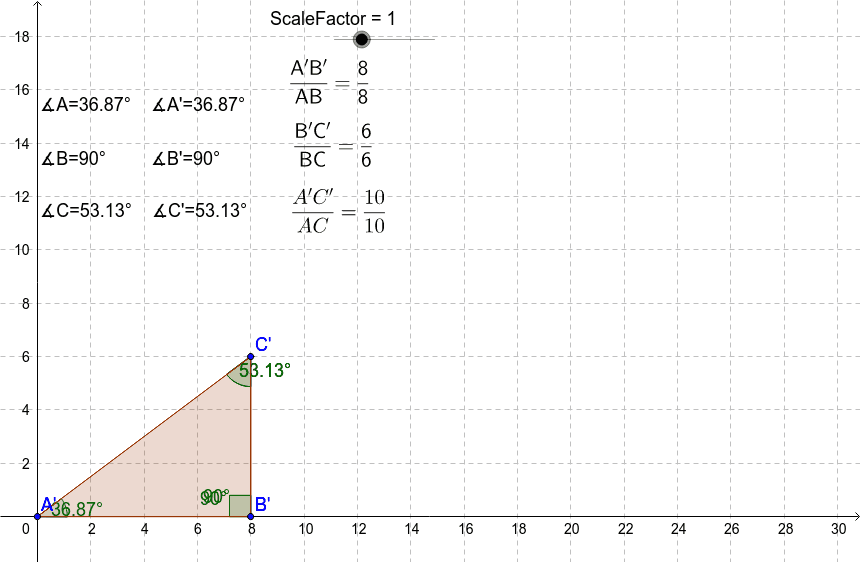
This example demonstrates how angle relationships are emphasized through geometric dilations. Core math concepts include angles, dilation transformations, distance measurement, and polygon constructions. GeoGebra commands like Point, Polygon, Dilate, Distance, and Angle are used to visually show the correspondence and angle changes between transformed and original figures. Suitable for high school mathematics education to understand properties of similar figures and angle invariance.
GeoGebra Commands & Parameters
Point(Circle[A, 8]) → BPolygon(A, B, C) → poly1, c, a, bDilate(A, ScaleFactor, A) → A'Dilate(B, ScaleFactor, A) → B'Dilate(C, ScaleFactor, A) → C'Polygon(A', B', C') → poly1', c', a', b'Distance(A, B) → ABAngle(B, A, C) → αAngle(A, C, B) → βAngle(A', C', B') → γAngle(C, B, A) → δAngle(C', B', A') → ε
AI Drawing Prompt Reference
Draw triangle ABC and then scale it from point A to get triangle A'B'C', showing corresponding vertices and edges before and after dilation. Measure and label angles α and β in triangle ABC, and angle γ in triangle A'C'B'. Also label angles δ in triangle ABC and ε in triangle C'B'A', emphasizing angle invariance in similar figures.
The prompt above was compiled from the original drawing commands and is for reference only.