
Angle Sum Property via Rotation
Loading the math board and drawing, please wait…
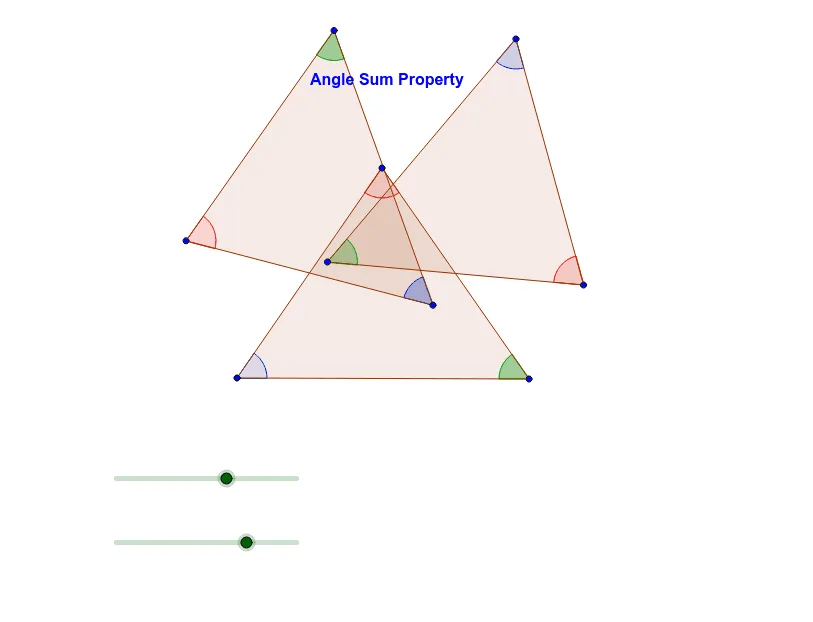
This example demonstrates the angle sum property of triangles through rotation transformations. It involves core concepts like rotation, angle sum, symmetry, and polygon properties. GeoGebra commands and objects used include Polygon, Midpoint, Rotate, and Angle. Suitable for high school mathematics education to understand geometric transformations and polygon characteristics.
GeoGebra Commands & Parameters
Polygon(A, B, C) → poly1, c, a, bMidpoint(c) → DMidpoint(b) → ERotate(A, (-α), E) → A'Rotate(B, (-α), E) → B'Rotate(C, (-α), E) → C'Polygon(A', B', C') → poly1', c', a', b'Rotate(A, β, D) → A'_1Rotate(B, β, D) → B'_1Rotate(C, β, D) → C'_1Polygon(A'_1, B'_1, C'_1) → poly1'_1, c'_1, a'_1, b'_1Angle(poly1) → γ, δ, εAngle(poly1'_1) → ζ, η, θAngle(poly1') → ι, κ, λ
AI Drawing Prompt Reference
Draw triangle ABC, then rotate it 180 degrees around the midpoint E of BC to get A'B'C'. Next, rotate the triangle 180 degrees around the midpoint D of the perpendicular bisector DE of BC to get A'_1B'_1C'_1. Finally, measure the angles of triangles ABC, A'B'C', and A'_1B'_1C'_1 to observe the angle properties.
The prompt above was compiled from the original drawing commands and is for reference only.