
Angle Comparison and Classification
Loading the math board and drawing, please wait…
In collections
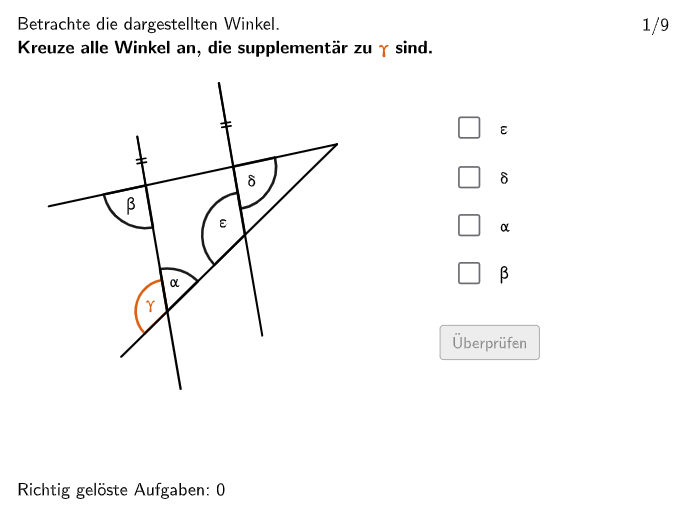
Besondere Winkelpaare
This example demonstrates how to compare and classify the sizes of different angles, including acute, right, obtuse, straight, reflex, and full angles. The core mathematical concepts involved are angle measurement and classification. Key GeoGebra commands used in construction include Join, SelectedIndex, Element, If, KeepIf, Zip, Point, Textfield, Polygon, Shuffle, Append, Remove, Angle, Sort, etc., to create and manipulate angle objects. Suitable for 5-6 grade students for teaching and practicing angle classification and measurement.
GeoGebra Commands & Parameters
Join(Sequence[Shuffle[Sequence[1, maxexnum]], m, 1, floor(110 / maxexnum)]) → listExNumsSelectedIndex(DropDown2Alt) → input2bSelectedIndex(DropDown2) → input2aElement(listwinkelart(exnum), 2) → winkelart2SelectedIndex(DropDown1Alt) → input1bSelectedIndex(DropDown1) → input1aElement(listwinkelart(exnum), 1) → winkelart1If(altDropDown2, input2b, input2a) → input2If(altDropDown1, input1b, input1a) → input1KeepIf(m ≠ 0, m, input0) → input0cleanZip(IndexOf[m, MCPosActual], m, sol0) → sol0realPoint(Line[H3, Vector[OrthogonalVector[Vector[H4, H5]]]]) → H2Textfield(input1) → InputBox1Textfield(input2) → InputBox2Polygon(PtopLeftCornerFeedback, PtopRightCornerFeedback, PbottomRightCornerFeedback, PbottomLeftCornerFeedback) → rectangleCorrect, rectangleCorrectS3, rectangleCorrectS4, rectangleCorrectS2, rectangleCorrectS1Shuffle(Sequence[Random[0, 10], i, 1, 100]) → randomNosForX, {4, 9, 5, 3, 10, 10, 3, 7, 9, 0, 9, 5, 4, 7, 8, 6, 8, 7, 10, 10, 10, 2, 10, 8, 10, 8, 3, 6, 5, 5, 10, 4, 2, 7, 9, 7, 9, 9, 0, 7, 7, 5, 0, 0, 0, 8, 7, 8, 8, 0, 1, 6, 9, 1, 5, 4, 4, 1, 8, 9, 5, 10, 8, 9, 4, 8, 2, 8, 3, 7, 0, 5, 0, 9, 5, 2, 5, 4, 10, 7, 2, 9, 9, 0, 5, 7, 8, 1, 1, 4, 8, 10, 0, 7, 8, 3, 9, 0, 6, 0}Element(randomNosForX, Mod[questionCount, 100] + 1) → numXShuffle(Sequence[Random[0, 10], i, 1, 100]) → randomNosForY, {4, 6, 6, 0, 10, 8, 10, 9, 8, 3, 7, 1, 3, 7, 3, 3, 1, 5, 10, 2, 3, 2, 8, 6, 0, 9, 0, 6, 0, 5, 5, 7, 8, 1, 0, 9, 3, 6, 10, 10, 8, 5, 10, 9, 1, 0, 7, 6, 7, 0, 4, 4, 4, 5, 10, 8, 1, 0, 10, 5, 8, 6, 2, 9, 5, 10, 3, 2, 4, 10, 9, 1, 6, 2, 10, 1, 2, 8, 7, 5, 10, 2, 2, 9, 7, 7, 9, 9, 1, 1, 10, 2, 8, 8, 9, 8, 1, 8, 4, 4}Element(randomNosForY, Mod[questionCount, 100] + 1) → numYAppend(true, Sequence[If[randomNosForX(i) ≟ randomNosForX(i - 1), false, true], i, 2, 100]) → stayXAppend(true, Sequence[If[randomNosForY(i) ≟ randomNosForY(i - 1), false, true], i, 2, 100]) → stayYRemove(Sequence[If[stayX(i), randomNosForX(i), 0], i, 1, 100], Sequence[0, i, 1, 100]) → randomNosForXwithoutRepeatRemove(Sequence[If[stayY(i), randomNosForY(i), 0], i, 1, 100], Sequence[0, i, 1, 100]) → randomNosForYwithoutRepeatElement(randomNosForXwithoutRepeat, Mod[questionCount, Length[randomNosForXwithoutRepeat]] + 1) → numXwithoutRepeatElement(randomNosForYwithoutRepeat, Mod[questionCount, Length[randomNosForYwithoutRepeat]] + 1) → numYwithoutRepeatPoint(Line[F3, Vector[F5, F4]]) → F2Point(Line[G4, Vector[OrthogonalVector[Vector[G6, G7]]]]) → G3Point(Segment[G6, G7]) → G5Point(Line[H2, Vector[OrthogonalVector[Vector[H4, H6]]]]) → H1Point(Line[C6, xAxis]) → C5Point(Line[C6, yAxis]) → C8Point(Line[E1, xAxis]) → E3Point(Line[E5, xAxis]) → E4Point(Line[E8, Vector[E7, E5]]) → E6Point(Line[E6, xAxis]) → E2Angle(A2, Intersect[Line[A1, A2], Line[A3, A4]], A3) → w1aAngle(A1, A2, A5) → w1bAngle(A2, Intersect[Line[A5, A2], Line[A3, A4]], A3) → w1cAngle(A3, Intersect[Line[A5, A2], Line[A3, A4]], A5) → w1dAngle(A5, Intersect[Line[A5, A2], Line[A3, A4]], A4) → w1eAngle(B1, Intersect[Line[B1, B2], Line[B7, B5]], B7) → w2aAngle(B6, Intersect[Line[B1, B2], Line[B6, B5]], B2) → w2bAngle(B5, Intersect[Line[B1, B2], Line[B7, B5]], B1) → w2cAngle(B4, Intersect[Line[B3, B4], Line[B6, B5]], B5) → w2dAngle(B3, Intersect[Line[B3, B4], Line[B7, B5]], B7) → w2eAngle(C6, Intersect[Line[C1, C2], Line[C6, C5]], C1) → w3aAngle(C2, Intersect[Line[C2, C1], Line[C8, C7]], C8) → w3bAngle(C8, Intersect[Line[C2, C1], Line[C8, C7]], C1) → w3cAngle(C1, Intersect[Line[C2, C1], Line[C8, C7]], C7) → w3dAngle(C2, Intersect[Line[C2, C1], Line[C3, C4]], C4) → w3eAngle(E7, Intersect[Line[E1, E3], Line[E7, E5]], E1) → w5aAngle(E3, Intersect[Line[E1, E3], Line[E8, E6]], E8) → w5bAngle(E1, Intersect[Line[E1, E3], Line[E8, E6]], E6) → w5cAngle(E4, Intersect[Line[E5, E4], Line[E7, E5]], E7) → w5dAngle(E8, Intersect[Line[E8, E6], Line[E2, E6]], E2) → w5eAngle(F5, Intersect[Line[F4, F5], Line[F6, F1]], F6) → w6aAngle(F4, Intersect[Line[F4, F5], Line[F6, F1]], F1) → w6bAngle(F1, Intersect[Line[F4, F5], Line[F6, F1]], F5) → w6cAngle(F3, Intersect[Line[F2, F3], Line[F6, F1]], F6) → w6dAngle(F6, Intersect[Line[F2, F3], Line[F6, F1]], F2) → w6eAngle(G5, Intersect[Line[G2, G4], Line[G1, G5]], G2) → w7aAngle(G4, Intersect[Line[G2, G4], Line[G1, G5]], G5) → w7bAngle(G3, Intersect[Line[G2, G4], Line[G4, G3]], G2) → w7cAngle(G6, Intersect[Line[G7, G6], Line[G3, G4]], G4) → w7dAngle(G3, Intersect[Line[G7, G5], Line[G3, G4]], G6) → w7eAngle(G1, G5, G7) → w7fAngle(G7, G5, G6) → w7gAngle(H2, Intersect[Line[H2, H3], Line[H4, H5]], H5) → w8aAngle(H2, Intersect[Line[H2, H3], Line[H6, H4]], H6) → w8bAngle(H5, Intersect[Line[H2, H1], Line[H4, H5]], H1) → w8cAngle(H2, Intersect[Line[H2, H1], Line[H4, H6]], H6) → w8dAngle(H6, Intersect[Line[H2, H1], Line[H4, H6]], H1) → w8eAngle(H5, H4, H6) → w8fAngle(H3, H2, H1) → w8gKeepIf(IndexOf[M, listwinkelnames] ≠ listwinkel(exnum), M, listwinkelnames) → listwinkelnamesextraZip(Length[m], m, listsol0) → listNumCorrectAnswersJoin({{sol0(1)}, {RandomElement[Sequence[1, 4] \ RemoveUndefined[{sol0(1), sol0(2)}]]}}) → MCSwapZip(If[a ∈ MCSwap, RandomElement[MCSwap \ {a}], a], a, MCPosActual) → MCPosNextSort({option1, option2, option3, option4}, MCPosActual) → optionsrealZip(listwinkelnamesextra(m), m, MCPosActual) → listwinkelnamesActual
AI Drawing Prompt Reference
Draw a diagram illustrating the classification of different angles. Include key angle objects such as acute, right, obtuse, straight, reflex, and full angles. These angles should be formed by connecting points and labeled accordingly. The construction order should be: first draw basic points, then connect points to create angles, and finally add labels to indicate angle classification. The diagram should be clear and suitable for teaching.
The prompt above was compiled from the original drawing commands and is for reference only.