
Angle Bisectors, Incenter & Incircle
Loading the math board and drawing, please wait…
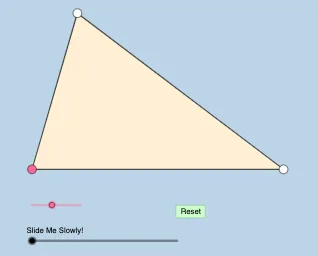
① This example demonstrates the construction of the three angle bisectors of a scalene triangle, their intersection at the incenter, and the incircle centered at the incenter, showing the relationship between angle bisectors and the inscribed circle. ② Core mathematical concepts include angle bisectors, the incenter (center of the incircle), tangency of the incircle to all three sides, and related angle and side length properties. ③ Construction highlights: using GeoGebra commands such as Rotate, Angle, Segment, Ray, Point, Polygon, Intersect, Min, Circle, OrthogonalLine, Dilate, CircleSector, and CircleArc, the triangle vertices A, B, C are defined, angle bisectors are drawn as rays, their intersection yields the incenter, and the incircle is constructed with the incenter as center; orthogonal lines and dilation assist in auxiliary constructions. ④ Suitable for middle/high school geometry lessons, competition training, or dynamic geometry exploration, helping students understand the incenter's properties and incircle construction.
GeoGebra Commands & Parameters
Rotate(A, (a * π / 180), B) → A'Angle(A, B, A') → αSegment(B, A) → fRay(B, A') → gPoint(g) → CSegment(A, C) → hSegment(B, C) → iPolygon(B, A, C) → t1, c, b, a_1Angle(C, A, B) → βAngle(B, C, A) → γRotate(C, β / 2, A) → C'Angle(C, A, C') → δRotate(A, α / 2, B) → A'_1Angle(A, B, A'_1) → εRotate(B, γ / 2, C) → B'Angle(B, C, B') → ζRay(B, A'_1) → jRay(A, C') → kRay(C, B') → lIntersect(j, k) → DMin({i, f, h}) → dCircle(B, (0.2 * d)) → eCircle(A, (0.2 * d)) → pCircle(C, (0.2 * d)) → qOrthogonalLine(D, f) → mOrthogonalLine(D, h) → nOrthogonalLine(D, i) → rIntersect(m, f) → EIntersect(n, h) → FIntersect(r, i) → GIntersect(e, j, 1) → HIntersect(p, k, 1) → IIntersect(p, h, 1) → JIntersect(e, f, 1) → KIntersect(q, i) → L,Intersect(q, l, 1) → MRotate(K, If[1 < o ≤ 2, ((o - 1) * ε), ε], B) → K'Dilate(B, If[0 < o ≤ 1, 1 - o, 0], D) → B'_1Segment(B, B'_1) → sCircleSector(B, K, K') → tRotate(t, If[3 < o ≤ 4, ((o - 3) * ε), ε], B) → t'Dilate(A, If[4 < o ≤ 5, 5 - o, 0], D) → A'_2Segment(A, A'_2) → f_1Rotate(J, If[5 < o ≤ 6, ((o - 5) * δ), δ], A) → J'CircleSector(A, J, J') → c_1Rotate(c_1, If[7 < o ≤ 8, ((o - 7) * δ), δ], A) → d_1Dilate(C, If[8 < o ≤ 9, 9 - o, 0], D) → C'_1Segment(C, C'_1) → h_1Rotate(L, If[9 < o ≤ 10, ((o - 9) * ζ), ζ], C) → L'CircleSector(C, L, L') → e_1Rotate(e_1, If[11 < o ≤ 12, ((o - 11) * ζ), ζ], C) → k_1Dilate(D, If[13 < o ≤ 14, 14 - o, 0], E) → D'Dilate(D, If[14 < o ≤ 15, 15 - o, 0], F) → D'_1Dilate(D, If[15 < o ≤ 16, 16 - o, 0], G) → D'_2Segment(D, D') → i_1Segment(D, D'_1) → j_1Segment(D, D'_2) → l_1Angle(D, E, B) → ηAngle(D, F, A) → θAngle(D, G, C) → ιAngle(E, D, F) → κAngle(F, D, G) → λRotate(D, If[17 < o ≤ 18, ((o - 17) * κ), κ], D) → D'_3Rotate(D', If[17 < o ≤ 18, ((o - 17) * κ), κ], D) → D''Segment(D'_3, D'') → m_1Rotate(D'_3, If[18 < o ≤ 19, ((o - 18) * λ), λ], D) → PRotate(D'', If[18 < o ≤ 19, ((o - 18) * λ), λ], D) → D'''Segment(P, D''') → n_1Rotate(G, If[19 < o ≤ 21, ((o - 19) * π), (2 * π)], D) → G'CircleArc(D, G, G') → p_1Circle(D, E) → q_1
AI Drawing Prompt Reference
Draw a scalene triangle. Construct the three internal angle bisectors, which intersect at a single point, the incenter. Draw the incircle centered at this incenter, tangent to all three sides of the triangle. From the incenter, drop perpendiculars to each side, marking the feet on the sides. Additionally, along each angle bisector from a vertex toward the incenter, create a small arc centered at that vertex, intersecting the bisector and the adjacent side, forming auxiliary sectors. This illustrates the relationship among angle bisectors, the incenter, and the incircle.
The prompt above was compiled from the original drawing commands and is for reference only.