
Angle Bisectors and Incenter: Incircle Discovery
Loading the math board and drawing, please wait…
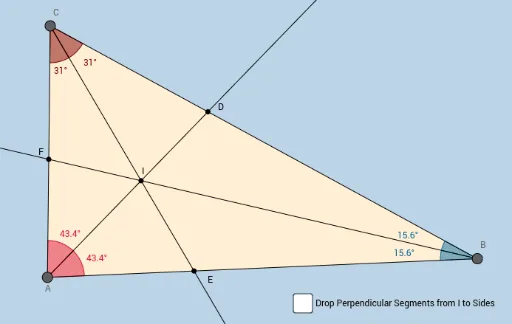
①This GeoGebra example demonstrates the incenter and incircle of a triangle through an investigative discovery approach. It shows that the three angle bisectors of a triangle are concurrent at a single point (the incenter), and the circle centered at this point tangent to all three sides is the incircle. ②Core mathematical concepts include angle bisectors, concurrency, incenter, incircle, distance from a point to a line, and the relationship between triangle area and semiperimeter. ③Construction highlights: using GeoGebra commands such as Segment, Polygon, Angle, Rotate, Line, Intersect, OrthogonalLine, and Circle to construct the triangle, its angle bisectors, the incenter, and the incircle; additional tools like PointIn and Slope support exploration. ④This is ideal for middle school or high school geometry classes, enabling students to discover the incenter theorem and the uniqueness of the incircle through guided questions, suitable for classroom activities or self-study.
GeoGebra Commands & Parameters
Segment(A, B) → fSlope(f) → mPointIn(b) → CSegment(B, C) → gSegment(C, A) → hPolygon(A, B, C) → poly1, c, a_1, b_1Angle(poly1) → α, β, γRotate(B, α / 2, A) → B'Angle(B, A, B') → δLine(A, B') → iIntersect(g, i) → DRotate(A, γ / 2, C) → A'Angle(A, C, A') → εLine(C, A') → jIntersect(j, f) → ERotate(C, β / 2, B) → C'Angle(C, B, C') → ζLine(B, C') → kIntersect(k, h) → FRay(C, E) → nRay(B, F) → pIntersect(p, n) → IAngle(I, A, C) → ηAngle(E, C, B) → θAngle(F, B, A) → ιRay(A, I) → lLine(A, C) → qSlope(q) → m_1OrthogonalLine(I, f) → rOrthogonalLine(I, g) → sOrthogonalLine(I, h) → tIntersect(t, h) → GIntersect(r, f) → HIntersect(s, g) → JSegment(I, H) → eSegment(I, J) → f_1Segment(I, G) → g_1Angle(I, H, A) → κAngle(I, J, B) → λAngle(I, G, C) → μ
AI Drawing Prompt Reference
Draw a triangle, then construct the three angle bisectors: start with the triangle’s three vertices and sides, create an angle-bisector line (ray/line) at each vertex so the three bisectors meet. Use the common intersection point as the incenter. From this incenter, construct the incircle that is tangent to all three sides, using the perpendicular (orthogonal) from the incenter to each side and the corresponding foot points to define the circle’s tangency setup. Keep the incenter, the bisector lines, and the three perpendicular segments to show the geometric relationships.
The prompt above was compiled from the original drawing commands and is for reference only.